• About Luis Falcon
  • Cookies & GDPR Privacy Policy

MeanMicio

~ Medicine. Open Science. Animal Rights.

MeanMicio

Tag Archives: tryton

GNU Health Conference at Medetel 2013

12 Friday Apr 2013

Posted by Luis Falcon in Uncategorized

≈ Leave a comment

Tags

ehealth, free software, gnu, GNU Health, GNU solidario, health, HMIS, Hospital Information System, Medetel 2013, phealth, tryton

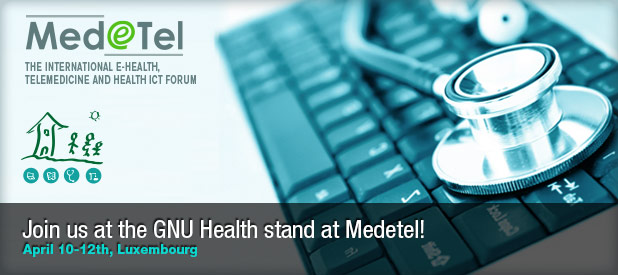
Don’t miss Sebastián Marró presentation. Today April 12th. at 11 AM in the Conference Room 4 – Medetel 2013 – 
“GNU Health: The Free Health & Hospital Information System”

Success of GNU Health goes beyond free software

19 Tuesday Mar 2013

Posted by Luis Falcon in Uncategorized

≈ Leave a comment

Tags

free software, fsf, GNU Health, GNU solidario, health information system, healthcare, HMIS, tryton

Please find below Luis Falcón’s interview about GNU Health in opensource.com

In 2006, Luis Falcón founded GNU Health, a free health information system that recently recieved the “Best Project of Social Benefit” award given by the Free Software Foundation.
GNU Solidario is the non-profit NGO behind GNU Health, started as a free software project for Primary Care facilities in rural areas and developing countries. Since then, it has evolved into a full Hospital and Health Information System used by the United Nations, public hospitals and Ministries of Health (such as in Entre Rios, Argentina), and private institutions around the globe.
GNU Health/Solidario and the United Nations International Institute for Global Health—UNU IIGH—signed an agreement in 2011 to train health professionals around the world on the system, as a way of promoting free software in public health, especially in emerging economies. Since then, both organizations have been cooperating and expanding their network of partners to deliver health in a universal way; which, also works towards the UN’s Millenium Development Goals.
Q: What are the top 3 ways that GNU Health is better than a proprietary system in use now?
A: GNU Health is an official GNU program and community-based project, so…
Administrators and providers can download GNU Health for free, study it, then adapt it to their needs.
There’s no vendor lock-in, because there’s no vendor. There are no hidden costs or upgrade scripts. Everyone will always be able to upgrade to the latest version for free.
There is an international community of support around GNU Health. We have community GNU Health demo server, documentation at WikiBooks, IRC channels, mailing lists, bug tracking systems, and a development environment.
Q: How does it go beyond cost?
A: Freedom and ethics.
GNU Health evolves from the talent, feedback, contributions of a constantly growing community.There are already academic institutions, like the United Nations and its International Institute for Global Health, teaching GNU Health to health professionals around the world. GNU Solidario, the non-profit organization behind GNU Health, delivers health and education with free software. We work with the United Nations and other institutions to provide primary care and preventive medicine and other of the MDG (Millenium Development Goals). For instance, we have a GNU Health module specific to MDG6, helping tof ight Malaria, HIV/AIDS and Tuberculosis. GNU Solidario also hosts the International Workshop on eHealth in Emerging Economies, a yearly conference focused on free software on eHealth, and how it can help organizations to improve the lives of their people. We have guests and participants from Doctors without Borders, United Nations, UNESCO, Red Cross, academic institutions, and health ministries. As you can see, it goes far beyond free of cost.
Q: Does GNU Health work in tandem with existing health systems or does it replace them?
A: It can do both.
In terms of health center management, GNU Health combines and integrates patient information from their electronic medical records (demographics, evaluations, medical history, labs, etc.) with the health center’s processes (accounting, human resources, stock, supply chain management, etc.). Any uncoupled systems (accounting, HR, EMR, SCM, etc.) can be replaced in order to optimize the resources and processes into one system.
GNU Health can also interoperate with other free software healthcare projects. For example, GNU Health can store patient medical images (MRIs, Xrays, CT, etc.) locally or connect directly to a PACS server using DICOM viewers like Ginkgo or Aeskulap. Interoperability in a hospital environment is a must and free software provides the tools to achieve more.
Q: Have most health administrators been eager or reluctant to implement an open source health system?
A: We have implemented GNU Health in both public hospitals and private institutions.
And they love the idea of having a system that belongs to them. GNU Health is a community-based project, so they are not tied to a software vendor; there are no licenses, hidden costs, or vendor lock-ins.
Q: Do providers have to buy new equipment and hire IT professionals to implement GNU Health?
A: It depends on the size and complexity of the center.
Hospital Information Systems deal with many aspects (accounting, stock, clinical records, suppliers, epidemiology, laboratory, pharmacy, security and access control, etc.). So, it’s no surprise that a well planned and designed project implemented by a well-trained local team will produce a high-quality product with a high level of sustainability.
Q: Why do you feel GNU Health benefits more patients, caregivers, and doctors than current systems?
A: In addition to being free software…
The system focuses on the human factor and takes a holistic approach to the patient—making concepts like health promotion, disease prevention, family medicine, and social determinants of disease top priorities. From a technical point of view, scalability and adaptability are key. Today there are over 20 different language and localization teams, making it easy for anyone to use GNU Health in their region.
Q: Does GNU Health provide high scalability?
A: GNU Health provides solutions for small offices and large hospitals.
The system’s modular design allows them to adapt its functionality to the complexity of their health center. GNU Health runs on top of the fantastic PostgreSQL database and we can implement it in a centralized or distributed environment. Plus, GNUHealth makes use of Python and Tryton frameworks; both are very scalable.
Q: Do you suggest other open source solutions to health providers and centers?
A: Absolutely.
Systems like Aeskulap or Ginkgo are excellent DICOM viewers. Bika Labs is a LIMS that can connect directly to GNU Health laboratory module. Tryton provides a robust and scalable framework to build enterprise solutions.
Q: What issues do we all need to better understand about our health?
A: Health is an issue for us all, whether we think about it much or not.
I encourage people to ask their politicians to adopt free software in the healthcare sector, because health is a public good. And thus, all health information systems should be based on free software. Public health and propietary software are antagonistic.
We, as individuals, should demand free software in our public administrations. And health professionals should know about free software and how it can help them, their patients, and their caregivers. Next time you go to the doctor, please tell her or him about the benefits of free software and write them a prescription for health.gnu.org!

main  source: http://opensource.com/health/13/3/interview-luis-falcon-gnu-health

GNU Health 1.8 is out, with Android support

21 Thursday Feb 2013

Posted by Luis Falcon in Uncategorized

≈ Leave a comment

Tags

AIDS, developing countries, free software, GNU Health, GNU solidario, Hospital Information System, Malaria, Public Health, tryton, tuberculosis, United Nations

From Luis Falcón blog:  
It’s been a couple of weeks since the release of GNU Health series 1.8, and we’re thrilled on the evolution of the system, and its adoption by the community.
This latest series is compatible with Tryton 2.6.x and has many improvements, in the core and reporting modules, among others. As usual, the migration from previous versions are included.

The other good news is that, being compatible with Tryton 2.6 allows the connection from mobile devices with the Android Operating System . 
Thanks to the great Tryton development framework, and to the fantastic job done by SCIL  in the development of the Android client for Tryton, GNU Health servers can now be accessed directly from your mobile device. 
 
You can find the Android client on Google Play . For the development process, check the SCIL page .

There are more good news on the way. The web client is also around the corner, and we will have 3 different ways to connect to GNU Health. From the standard GTK interface, the Android client, or your web browser.

Make sure you upgrade your database to the latest GNU Health version. The upgrade scripts and the instructions are always incorporated in the new version. The upgrade process is an integral part of GNU Health and, of course, it’s completely free.
e-Health for all !

About GNU Health

GNU Health is a free Health and Hospital Information System that provides the following functionality : 

  •     Electronic Medical Record (EMR)
  •     Hospital Information System (HIS)
  •     Health Information System (Epidemiology)


GNU Health has been awarded the Best Project of Social Benefit from the Free Software Foundation in 2012. 

In 2013, GNU Health received the awards for  most revolutionary Free Software and software with the largest potential from PortalProgramas.

GNU Health is an  official GNU Package , chosen by Richard Stallman, and is part of GNU Solidario. GNU Solidario is a NGO that delivers education and health to emerging economies with free software. GNU Health is the Hospital Information System chosen by the United Nations International Institute of Global Health.  GNU Solidario and the United Nations University, International Institute for Global Health have signed an agreement to implement and to train GNU Health globally.

Features of GNU Health latest version 1.6.4

25 Thursday Oct 2012

Posted by Luis Falcon in Uncategorized

≈ Leave a comment

Tags

CAGE, ehealth, free software, gnu, GNU Health, gynecology, lifestyle, nursing, obstetrics, pediatrics, pregnancy, PSC, tryton

From Luis Falcón:
I am happy to announce the release of GNU Health 1.6.4 ! This version brings many improvements, especially in the Obstetrics and Nursing modules. A quick summary : 

Features
Gynecology and Obstetrics module

  • Functionality covers pre-conception; genetic and nutrition counseling; prenatal evaluations; antenatal and intrapartum monitoring; labor and puerperium
  • Improve obstetrics views and navigation
  • Automatic Pregnancy due date calculation from last menstrual period (LMP)
  • Pregnancies include the prenatal, antepartum and puerperium
  • Automatic, functional notification of patient pregnancy
  • Automatic computation of gestation age
  • Improved prenatal evaluation information
  • Include ultrasound information

*Fetal biometry and activity
*IUGR and its forms
*Simplify end of birth recording, as well as maternal death information
*Include preeclampsia, invasive placentation and other abnormalities during pregnancy

Lifestyle

  • Include CAGE alcoholism score

Pediatrics

  • Optimize Pediatric Symptoms Checklist for psychosocial risk

Nursing

  • New outpatient / ambulatory care functionality

Installation Notes

Please follow the instructions at the Wikibook GNU Health documentation Portal : http://en.wikibooks.org/wiki/GNU_Health 

Upgrade Notes

There are no specific notes for this upgrade, so upgrading your previous GNU Health version should be straight forward. Of course, before any upgrade, please backup your database and follow the general upgrade instructions at the GNU Health Wikibook:http://en.wikibooks.org/wiki/GNU_Health/Upgrade 

Ponentes confirmados para la 1ª Conferencia Nacional de e-Salud, Buenos Aires

26 Wednesday Sep 2012

Posted by Luis Falcon in Uncategorized

≈ Leave a comment

Tags

argentina, buenos aires, CISL 2012, e-salud, ehealth, free software, GNU Health, GNU solidario, Salud Pública, software libre, thymbra, tryton


Dr. Donato Spaccavento
Secretario de Salud de la Ciudad de Buenos Aires. El Dr. Spaccavento se desempeñó previamente como director del Hospital Argerich, en el barrio de La Boca, y fue ministro de salud durante la intervención de la provincia de Santiago del Estero. Entre sus antecedentes docentes, se cuenta la participación en el Departamento de Farmacología de la Facultad de Medicina, UBA. 

Ing. Raúl Zambrano
Senior Policy Advisor en TIC y Gobernabilidad para la UNDP (United Nations Development Programme), New York. Durante los últimos 20 años, ha apoyado el desarrollo y uso de la Información y las Comunicaciones (TIC) en más de 80 países en desarrollo para fomentar programas de desarrollo, en colaboración con los gobiernos nacionales y las organizaciones de la sociedad civil. Actualmente está concentrado en las políticas de gobierno electrónico y programas que permitan mejorar la información pública y la prestación de servicios a los pobres y promover la e- participación. También ha apoyado el uso de software libre en los países en desarrollo desde 1995. Antes de unirse a la UNDP en 1993, el Sr. Zambrano trabajó en el sector académico en los EE.UU. Tiene experiencia en ingeniería, sociología y economía.

Ing. Luis Falcón
(Las Palmas, España, 1970) posee un título en Computer Science y Matemáticas de California State University at Northridge. Actualmente vive en Buenos Aires, Argentina donde estudia la carrera de Medicina.Es el fundador y CEO de Thymbra, una empresa de consultoría especializada en ERPs y en Informática Médica en Software Libre. En 2006 Luis fundó GNU Solidario. GNU Solidario es una organización sin fines de lucro cuyo objetivo está dirigido a países en desarrollo, en las tareas de educación y salud. Luis Falcón es un activista social, de los derechos de los animales y del Software Libre. Es el autor de GNU HEALTH, el sistema de gestión hospitalaria y de información de la salud, ganador de diversos premios internacionales, incluido el “Best Project of Social Benefit 2011″ de la Free Software Foundation. Focalizado en economías emergentes, GNU Health hoy se usa en Latinoamérica, Europa, África y Asia”

Dr. Luis Simes
Prosecretario de Planificación. Delegado Rectoral Sede La Rioja. Director Carrera de Tecn. en Análisis Clínicos. Miembro del Comité de Ética.Instituto Universitario de Ciencias de la Salud, Fundación H.A.Barceló. Miembro del Comité Asesor del Centro de Investigación, Formación y Transferencia en Gestión de Laboratorios de la Escuela de Salud Pública de la Facultad de Ciencias Médicas de la Universidad Nacional de Córdoba.

Dr. Armando Pacher
Doctor en Medicina. Especialista en Cardiología. Profesor Titular Ordinario de Fisiopatología en Bioingeniería de la Facultad de Ingeniería de la Universidad Nacional de Entre Ríos – FIUNER. Ex-Decano y Ex-Vicedecano de FIUNER. Director del Master a distancia en Telemedicina de FIUNER. Editor Asociado de la Revista de la FAC. Director del Grupo CETIFAC – FAC-FIUNER. Director del Grupo de Trabajo en Telemedicina – FIUNER. Director del Campus Virtual FAC-FIUNER. Coordinador del Master a Distancia en Cardiología – FAC-Sociedad Española de Cardiología-Universidad M. Hernández. Secretario de Informática Médica de FAC. Presidente del Comité Técnico-Organizador de los siete Congresos Internacionales de Cardiología por Internet (1998-2011)

Dr. Roberto Baistrocchi
Miembro del Consejo Científico Asesor de SEDRONAR
Profesor Titular de Farmacología. Facultad de Medicina, Fundación Barceló. Profesor Titular de Adicciones I. Instituto de Drogadependencias, Universidad del Salvador. SubDirector de la Maestría en Neuropsicofarmacología, Fundación Barceló. Ex Secretario general del Colegio Argentino de Neuro psico Farmacología. Miembro Activo de la Urban Mental Health, capítulo de la World Psychiatric Association. Miembro de REDLA, red Latinoamericana de Adicciones.

Bioing. José A. Giacopuzzi
Actualidad Director de Bioingeniería, nombrado por Decreto del Sr Gobernador.-N 2502/2011. Dependiente del Ministerio de Salud de la Provincia de Entre Ríos.
Coordinador RED DE INTEGRACION REGIONAL DEL MERCOSUR (REDIREM). Coordinador Provincial del Proyecto Banco del Pueblo. Jefe de Mantenimiento de instalaciones y equipamiento Médico del Hospital Delicia Concepción Masvernat de Concordia. Jefe de Trabajos Prácticos de la cátedra de Biofísica. Carrera de Enfermería , Sub Sede Villaguay, FCVYS UADER. Coordinador Académico Administrativo Sub Sede Concordia. Facultad de Ciencias de la Vida y la Salud UADER (Delegado de la Decana de la Facultad de Ciencias de la Vida y la Salud). Inspector de Empaques de Frutas Cítricas. Programa de Exportación UE SENASA.

Lic. Darío C. Reisenauer
Jefe Depto. Informática. Ministerio de Salud Prov. Entre Ríos
Asesor Informático ad honorem para la Provincia de Entre Ríos del “Registro Provincial de Tumores”. Sistema CanReg4. 2003 en adelante. Perito Informático para el Superior Tribunal de Justicia de Entre Ríos desde 2006.

Dr. Fernando Plazzotta
Hospital Italiano. Médico egresado de la Universidad de Buenos Aires
(Argentina) y egresado de la Residencia de Informática Médica del Hospital
Italiano de Buenos Aires (HIBA), donde actualmente se desempeña como médico de planta del Departamento de Informática en Salud. Es profesor asistente en el Cátedra de Informática Médica del Instituto Universitario – Escuela de Medicina del HIBA y el Instituto Universitario CEMIC.

Dr. Hugo E. Arce
Médico sanitarista, Universidad de Buenos Aires (UBA).Especialista en Salud Pública, certificado por el Consejo de Certificación de Profesionales Médicos (CCPM), patrocinado por la Academia Nacional de Medicina. Director, Departamento de Salud Pública (DSP), Instituto Universitario de Ciencias de la Salud (IUCS), Fundación H. A. Barceló. Director, Diplomatura en Calidad de Servicios de Salud, programa de Educación a Distancia, IUCS, Fund. Barceló. Autor de varios libros como: “El Sistema de Salud: de dónde viene y hacia dónde va, Ed. Prometeo”, Buenos Aires, 2010.


Dr. Jorge Giana
Director ejecutivo ALPI Asociación Civil
Director médico OSDEPYM

Lic. Oscar A. Lagiglia
Actualmente Secretario General de la Asociación Gremial de Computación – A.G.C. Asociación con inscripción gremial desde 1992, se suma a la organización y asume como Secretario General en 1995, a su vez ocupo  cargos gerenciales en distintas empresas, en los últimos años se especializo en seguridad social y trabajo como Gerente de Informática y Comunicaciones  en importantes Obras Sociales. Lagiglia fue integrante de C.E.S., presidente Software 90, primera muestra de Software en el Sheraton Hotel, durante estas importantes jornadas nace C.E.S.S.I  tras la fusión  de C.E.S (cámara de Empresas de Software) y C.A.E.S.C.O. (Cámara Empresaria de Servicios de Computación), cumplió tareas de Secretario en dos periodos, retirándose en 1995. Ha participado en foros/eventos/presentaciones sobre Software en Argentina  y del exterior. Curso sus estudios terciarios en la Universidad del Salvador.

Dr. Hugo Góngora Jara
Médico Egresado de la Universidad Nacional de Córdoba, es Especialista en Patología y Medicina Forense y Jefe de Servicio de Patología del Hospital Regional Dr. Enrique Vera Barros de La Rioja. En la Facultad de Medicina del IUCS Fundación Héctor A. Barceló – Sede La Rioja es Prof. Titular de Histología, Prof. Asociado de Patología, Coordinador del Curso de Investigación (en Teleconferencia con Buenos Aires) y Co secretario de Ciencia y Tecnología. Ha participado activamente como autor en numerosos Congresos Virtuales Hispanoamericanos de Patología Estática y Dinámica y ha escrito textos sobre Microscopía Virtual, Telepatología y Educación a Distancia. Es además Director Científico del Instituto Latinoamericano de e-Salud (Fundado el 13 de Setiembre de 2012 en Lima-Perú) y Ex Becario de JICA en la Tokyo Medical and Dental University y en el National Cancer Center de Tokyo, Japón.

Ing. Edgardo Genini
Consultor independiente en ingeniería de software, programador autodidacta desde 1996 con mas de 8 años de experiencia en sistemas transaccionales en el área de salud tanto privada como públicas, ejerciendo los roles de analista programador, diseño de software, jefe de desarrollo, líder de proyecto, arquitecto, jefe de arquitectura. Dictado de capacitaciones UML, definición de procesos, team member en SCAMPI CMMI level 3. Selección y capacitación de equipos para el desarrollo de software.

Lic. Walter Fernandez
Actualmente Gerente de Informática y comunicaciones en OSDEPYM, Licenciado en Sistema  en la Universidad Católica de la Plata y Magister en Administración de Empresas otorgado por la Universidad del CEMA. Estuvo a cargo de la implementación de sistemas transaccionales On-Line en varias obras sociales provinciales mediante la utilización de software libre.

Ing. Carlos Juan Martín Pérez
Director de TIC en el Ministerio de Salud de El Salvador.
Ingeniero en Informática por la ETSI Informática de la Universidad de Málaga, España. Máster en Administración de Tecnologías de Información y Comunicaciones (énfasis en administración de proyectos) por la Universidad Nacional de Costa Rica (UNA). Profesor en la Escuela de Informática de la Universidad Nacional de Costa Rica (2009). Responsable de los sistemas de información de Postgrado de la Universidad Nacional de Costa Rica (SEPUNA. 2008). Coordinador de la Unidad de Desarrollo del Sistema de Información Académico (Adacad) de la UES (2003/2007). Profesor ad-honorem en la Facultad de Ciencias Naturales y Matemática de la Universidad de El Salvador (UES) y en la Facultad de Ingeniería y Arquitectura. Activista del Software libre desde 2001 en: Asociación de usuarios/as de GNU/Linux de El Salvador (SVLinux). Grupo de usuarios/as de software libre de la UES (LinUES). Grupo de usuarios/as de software libre de la UNA (UNA Alternativa). Red costarricense de software libre, RCSL. Comunidad salvadoreña de software libre, SLSV. Comunidad centroamericana de software libre, SLCA. Socio de la Asociación Malagueña de Ingeniería Sin Fronteras (desde 1994).

Dr. Mariano José Sturmer 
Abogado recibido con diploma de honor en la Universidad de Buenos Aires, y ha complementado su formación profesional con diversos cursos y programas referidos a Recursos Humanos y Derecho del Trabajo. Desde hace más de diez años se ha desempeñado en el área de recursos humanos de prestigiosas empresas multinacionales e instituciones ligadas al sector de la salud, siendo en la actualidad Jefe de Capital Humano de la Fundación H. A. Barceló (desde 2007).

Lic. Myrna Marti
Especialista en Redes, Cooperación Técnica y Asociaciones del área de Gestión del conocimiento y comunicaciones de la Organización Panamericana de la Salud – PAHO. Psicóloga y con un posgrado en Dirección de Sistemas de Información. En su paso por la OPS se desempeñó como Jefa de Tecnología de la Información en el Instituto Panamericano de Protección de Alimentos y Zoonosis, Asesora en Desarrollo Institucional en la Sede Regional y Asesora en Gestión del conocimiento y comunicaciones. Actualmente forma parte del equipo que coordina el programa de eSalud de la Organización Panamericana de la Salud.

Lic. Omar Rodriguez
Contador Público. Experto en Seguridad Social (Oiss). Experiencia en tratamiento de información masiva en todos los ámbitos de la Seguridad Social. En la actualidad Gerente de Operaciones Osdepym y Secretario de Acción Social en Asociación Gremial de Computación.


Lic. Walter R. Elias
Licenciado en Bioinformática egresado de la Universidad Nacional de Entre Ríos. Socio gerente de Oro Verde Digital SRL. Miembro de LUG Paraná. Vicepresidente del Colegio de Profesionales de Ciencias Informáticas de Entre Ríos. Miembro del primer Aglomerado Productivo de Tecnología Médica y del Primer Aglomerado Productivo de Tecnologías Libres de Argentina. Integrante del Polo Tecnológico de la Ciudad de Paraná.

GNU Health version 1.6.3 released

29 Wednesday Aug 2012

Posted by Luis Falcon in Uncategorized

≈ Leave a comment

Tags

free software, fsf, gnu, GNU Health, tryton, United Nations, UNU-IIGH, upgrade

 
From Luis Falcón:
We are proud to announce the release of GNU Health 1.6.3. This version brings major improvements in the hospital information system, both from the administrative and patient management. Here is a quick summary of the main changes :

** Features **
  • Patient Nutrition management. Complex combinations that take into account therapeutics, pre-existing conditions, surgeries, lifestyles,
  • vegetarianism and other belief-based diets.
  • Inpatient medication medication and history log
  • New nursing module
  • Nursing roundings ( evaluations, procedures, medications … )
  • New user profiles (doctors, nurses, clerks, …)
  • New appointment reports
  • Improved standard security profiles
  • The translation project is now entirely done from Transifex, so the health center will install only the languages they need
  • Revised and improved look and feel, from views to icons
  • Many models datafiles ( medicaments, WHO essential meds, .. ) can be now modified from the client.
  • Improve installation scripts and Archlinux support
  • Improve search patient methods
  • Bugfixes
** Credits **

Thanks to all of you who have collaborated in the mailing lists and IRC channels. The end users, developers, tryton community. Many thanks to the GNU community and to the Free Software Foundation for hosting GNU Health.

Thanks to organizations like the United Nations InternationalInstitute for Global Health -UNU IIGH – for their commitment with GNU Health. UNU is giving GNU Health trainings and capacity building to countries in Asia an Africa,

** Upgrade Notes **

There is no specific notes for this upgrade, so upgrading your previous GNU Health version will be straight forward. Please follow the general upgrade instructions at the GNU Health Wiki.

1ª Conferencia Nacional de e-Salud: Buenos Aires, 16 de Octubre 2012

13 Monday Aug 2012

Posted by Luis Falcon in Uncategorized

≈ Leave a comment

Tags

argentina, buenos aires, CISL 2012, e-salud, ehealth, free software, GNU Health, GNU solidario, Salud Pública, software libre, thymbra, tryton

Impulsada por la ONG GNU Solidario y con el patrocinio de CISL Argentina y Thymbra, se llevará a cabo por primera vez en Argentina la I Conferencia Nacional de e-Salud. 
Expertos de Europa y Latino América se darán cita en la ciudad de Buenos Aires, para intercambiar experiencias y debatir estrategias para que las administraciones públicas y los gobiernos adopten el Software Libre en la Salud Pública, de modo que todas las personas puedan tener acceso a una atención sanitaria de calidad.

El evento buscará promover el Software Libre como uno de los principales pilares para un marco sostenible para proporcionar e-salud y educación para países de economías emergentes.
La conferencia va más allá de lo netamente técnico. Vamos a discutir las herramientas que podemos ofrecer hoy a profesionales e instituciones.
Algunos de los temas de debate serán:

– El Software Libre en el sector de la salud
– e-Salud en Salud Pública
– Necesidad de Estándares Libres en e-Salud

La base del trabajo de GNU Solidario es proporcionar salud y educación con Software Libre, fundamentales para el desarrollo y dignidad de las sociedades.

En las proximas semanas estaremos publicando el programa del evento. No se olvide de enviar su propuesta, GNU Solidario le da la oportunidad de participar en el evento con una breve charla !

La entrada es libre y gratuita pero necesita registrarse previamente

Para más info sobre:
Ponentes 
Programa
info@gnusolidario.org

GNU Solidario y Ministerio de Salud de Entre Ríos

03 Tuesday Jul 2012

Posted by Luis Falcon in Uncategorized

≈ Leave a comment

Tags

entre rios, free software, gnu, GNU Health, governments, ministerio salud, Salud Pública, tryton

Esta tarde GNU Solidario ha recibido en sus oficinas de Buenos Aires la visita del Bioingeniero José Giacopuzzi (Dirección de Bioingeniería) y del Licenciado Dario Reisenauer (Departamento Informática) del Ministerio de Salud de Entre Ríos.
Durante la charla, Luis Falcón y Sebastián Marró presentaron GNU Health, el sistema de Gestión Hospitalaria y de Salud de Software Libre. 
Ha sido un placer conocerlos y presentarles nuestro trabajo. Estamos muy contentos por el interés mostrado en GNU Health por los representantes del Ministerio de Salud de Entre Ríos !
C. Melgosa, S. Cordara, L. Falcón, D. Reisenauer, J. Giacopuzzi, S. Marró

GNU Health Demo database server

27 Wednesday Jun 2012

Posted by Luis Falcon in Uncategorized

≈ Leave a comment

Tags

demo server, ehealth, free software, gnu, GNU Health, GNU solidario, Public Health, tryton

We are very pleased to announce that GNU Health has a new demo database server in Amsterdam.
This demo server will allow you to connect and try GNU Health easily. As you know, first you need to download and install the Tryton application, according to your operating system:
GNU/Linux
Windows
MacOS X 
Please find all the info about Installing the Demo Database and trying it online by clicking on the following image:
Please, remember to help GNU Solidario in delivering Health and Education with Free Software by becoming a member !! 

Join our membership !

21 Thursday Jun 2012

Posted by Luis Falcon in Uncategorized

≈ Leave a comment

Tags

free software, gnu, GNU Health, GNU solidario, membership, tryton

We created a membership for GNU Solidario.

When you donate as an associate member, you support the GNU Solidario mission to Deliver Education and Health in developing countries through Free Foftware. 

Some of the benefits of being an associate member are: 
  • GNU Solidario member button
  • 20% Discount on GNU Solidario Merchandise 
More info at: Join Us
← Older posts
Newer posts →

Recent Posts

  • Gracias, India
  • Parallel and distributed computing in GNU Health
  • El cambio de horario es un atentado contra la salud. Rechazarlo es la mejor medicina
  • Tu finca, su infierno
  • La Cátedra de Animales y Sociedad de la URJC: Un referente de empatía y respeto hacia los animales.

Archives

  • September 2025
  • May 2025
  • March 2025
  • February 2025
  • May 2024
  • July 2023
  • March 2023
  • February 2023
  • January 2023
  • October 2022
  • August 2022
  • April 2022
  • February 2022
  • September 2021
  • August 2021
  • July 2021
  • June 2021
  • March 2021
  • December 2020
  • September 2020
  • July 2020
  • May 2020
  • March 2020
  • February 2020
  • November 2019
  • October 2019
  • June 2019
  • April 2019
  • May 2018
  • November 2017
  • October 2017
  • June 2017
  • May 2017
  • April 2017
  • March 2017
  • February 2017
  • January 2017
  • December 2016
  • November 2016
  • October 2016
  • September 2016
  • August 2016
  • July 2016
  • June 2016
  • May 2016
  • April 2016
  • March 2016
  • February 2016
  • January 2016
  • November 2015
  • October 2015
  • September 2015
  • August 2015
  • July 2015
  • May 2015
  • March 2015
  • February 2015
  • January 2015
  • December 2014
  • October 2014
  • September 2014
  • July 2014
  • June 2014
  • May 2014
  • April 2014
  • March 2014
  • December 2013
  • November 2013
  • October 2013
  • September 2013
  • August 2013
  • July 2013
  • June 2013
  • May 2013
  • April 2013
  • March 2013
  • February 2013
  • January 2013
  • December 2012
  • November 2012
  • October 2012
  • September 2012
  • August 2012
  • July 2012
  • June 2012
  • May 2012
  • April 2012
  • March 2012
  • February 2012
  • January 2012
  • December 2011
  • November 2011
  • October 2011
  • September 2011
  • August 2011
  • July 2011
  • June 2011
  • May 2011
  • April 2011
  • March 2011
  • February 2011
  • January 2011
  • December 2010
  • November 2010
  • October 2010
  • September 2010
  • August 2010
  • July 2010
  • June 2010
  • May 2010
  • April 2010
  • March 2010
  • February 2010
  • January 2010
  • December 2009
  • November 2009
  • October 2009
  • September 2009
  • August 2009
  • July 2009
  • June 2009
  • May 2009
  • February 2009
  • November 2008
  • October 2008
  • September 2008
  • December 2007
  • October 2006

Categories

  • #FHIR
  • animal liberation
  • animal rights
  • embedded
  • events
  • gnu
  • GNU Health
  • GNU solidario
  • HMIS
  • KDE
  • Libre Software
  • LIMS
  • medical
  • MyGNUHealth
  • Public Health
  • thalamus
  • tryton
  • Uncategorized

Meta

  • Create account
  • Log in
  • Entries feed
  • Comments feed
  • WordPress.com

Blog at WordPress.com.

  • Subscribe Subscribed
    • MeanMicio
    • Already have a WordPress.com account? Log in now.
    • MeanMicio
    • Subscribe Subscribed
    • Sign up
    • Log in
    • Report this content
    • View site in Reader
    • Manage subscriptions
    • Collapse this bar