• About Luis Falcon
  • Cookies & GDPR Privacy Policy

MeanMicio

~ Medicine. Open Science. Animal Rights.

MeanMicio

Tag Archives: Hospital Information System

Reflexiones acerca de GNU Health en la sesión de la UIT – OMS WSIS 2013

27 Monday May 2013

Posted by Luis Falcon in Uncategorized

≈ Leave a comment

Tags

developing countries, ehealth, EMR, esalud, free software, GNU Health, GNU solidario, HMIS, Hospital Information System, ITU, phealth, Public Health, tryton, WHO, World Health Organization, WSIS

From Luis Falcon’s blog (english version)
En este mes de mayo he tenido el gran privilegio de ser invitado a participar como ponente en la sesión de la Unión Internacional de las Telecomunicaciones (UIT) y de la Organización Mundial de la Salud (OMS) : “TICs para la Mejora de la Información y Responsabilidades de la Salud Materno-Infantil” en la Cumbre Mundial sobre la Sociedad de la Información – WSIS 2013 Forum.

 
El titulo de mi presentación fue: “GNU Health: Mejorando la Salud de Niños y Madres con el Software Libre” y se realizó el día 14 de mayo, con una transmisión de la misma en vivo por Internet.
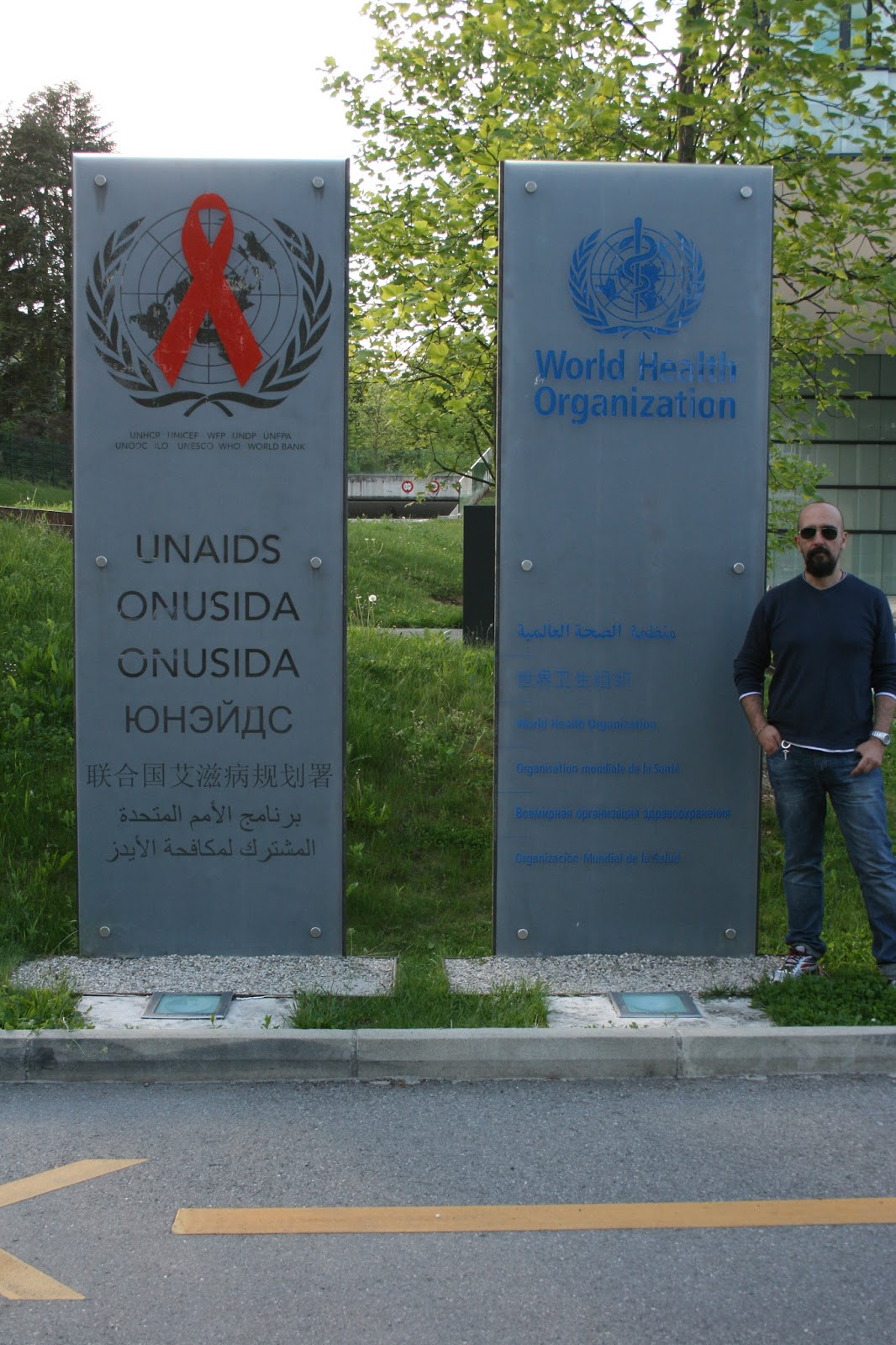
Oficinas Centrales de la Organización Mundial de la Salud en Ginebra

No puedo dejar de pensar en los tremendos niveles de mortalidad materno-infantil, la mayoría por enfermedades prevenibles. Estos pensamientos son el motor principal para el desarrollo de GNU Health, una herramienta con Software Libre que puede mejorar la salud de millones de personas en países en desarrollo.

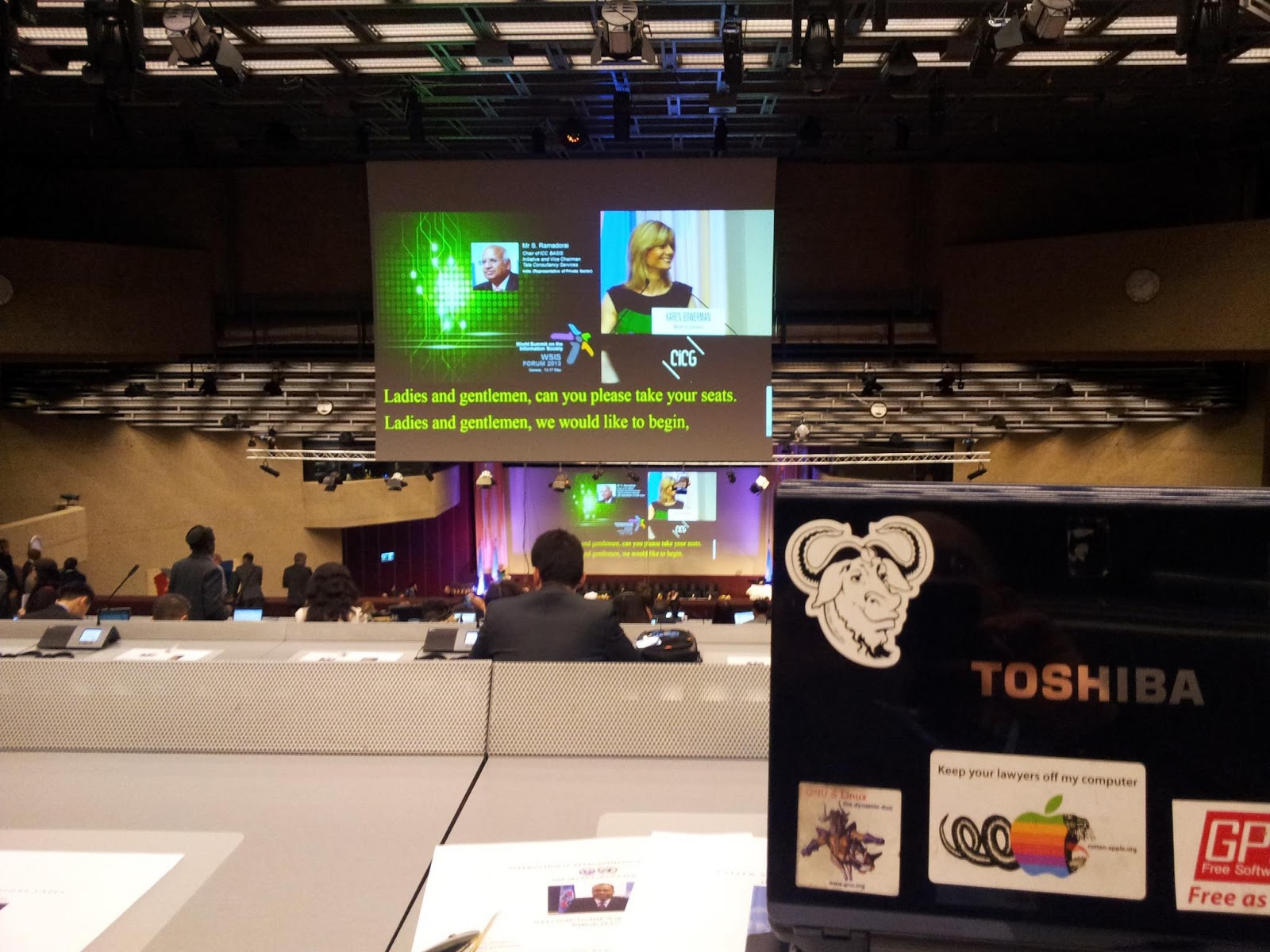
Opening Session en WSIS 2013
GNU Health tiene su foco principal en la Atención Primaria y en la Declaración de Alma Ata. Nosotros solo cambiamos una letra de esa declaración, transformando el original “Salud para Todos” en “e-Salud para Todos”.

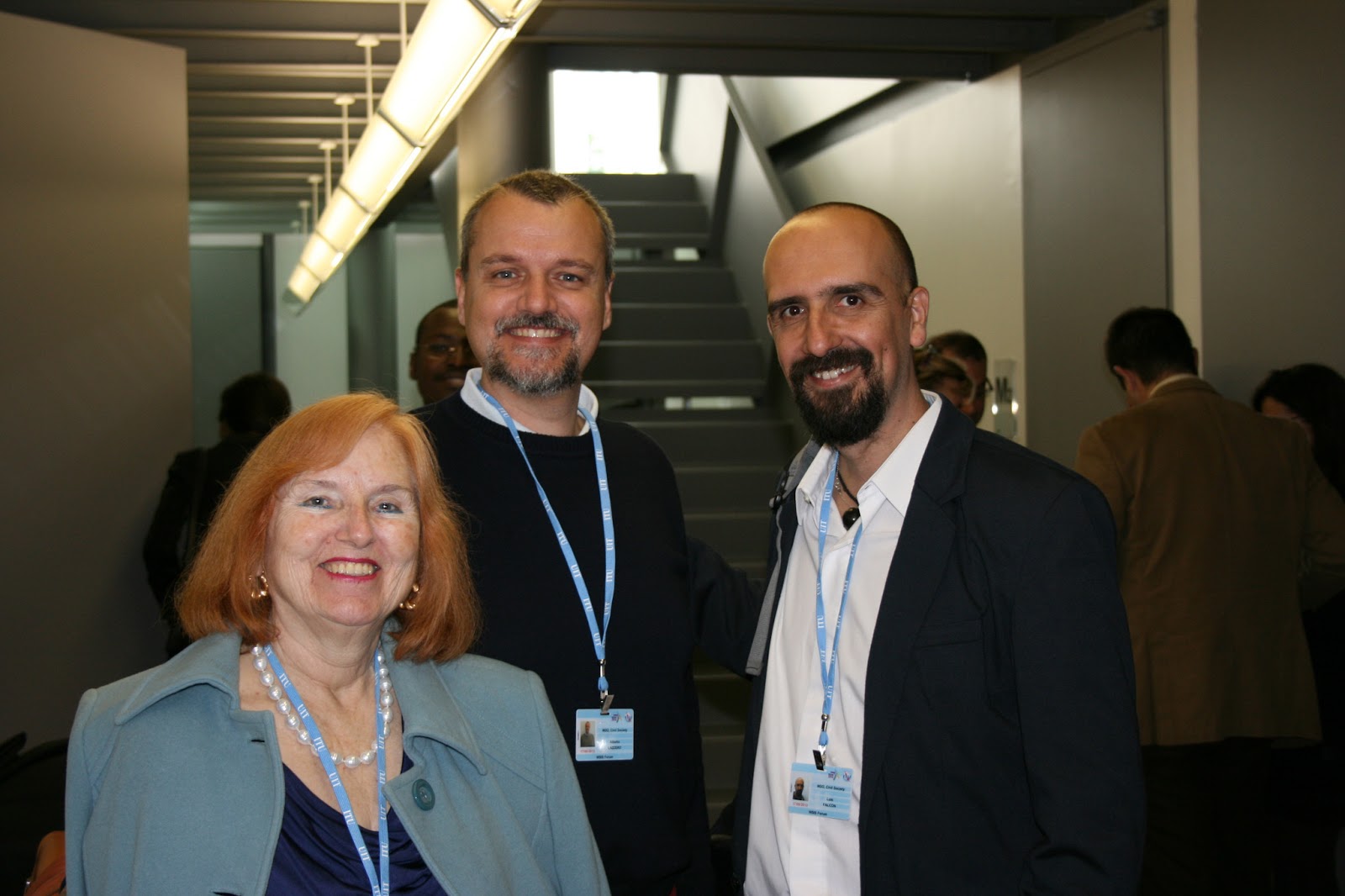
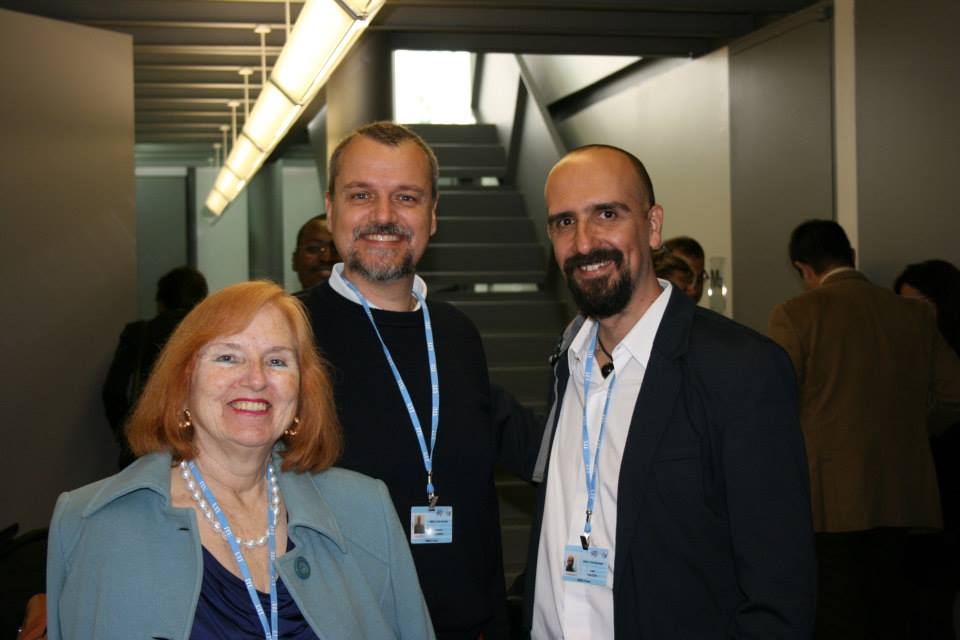
Tily Martín y Miguel Falcón de GNU Solidario

De esta manera luchamos para que la Salud y e-Salud sean un bien público. Los gobiernos deberían utilizar el Software Libre como una forma de lograr políticas de Estado sostenibles en el ámbito de la salud pública.
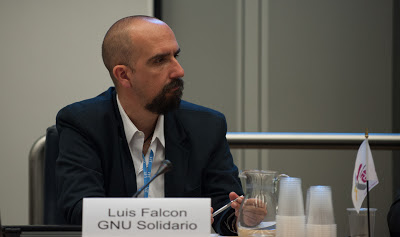
Luis Falcón en su sesión
Es desgarrador ver a países pagar millones de dólares a corporaciones extranjeras en licencias de software privativo. Deberían mejor pensar en utilizar ese dinero para potenciar la promoción de la salud; las campañas de prevención de enfermedades, o mejorar los salarios de los profesionales de la salud o la infraestructura de muchos centros, por mencionar algunas ideas. 
Para continuar con los conceptos de la  Declaración de Alma Ata y con la Atención Primaria de la Salud, la tecnología médica debe ser accesible, asequible y factible. No es necesario adquirir sistemas costosos o de ciencia ficción, en la Atención de la Salud lo que necesitamos son herramientas asequibles y eficaces.

Tily Martín, Dr. Alberto Lazzero y Luis Falcón

En mi charla presenté el caso de la implementación de GNU Health en un Hospital Público de Entre Ríos, Argentina. GNU Health gestiona los datos demográficos de la ciudad, la información socioeconómica de las familias, las evaluaciones de los pacientes, los análisis de  laboratorio, farmacia y stock, hospitalización, contabilidad financiera y RRHH, para mencionar algunos de los procesos utilizados. El centro sólo tuvo que invertir en la compra de computadoras para las oficinas de los profesionales de la salud.
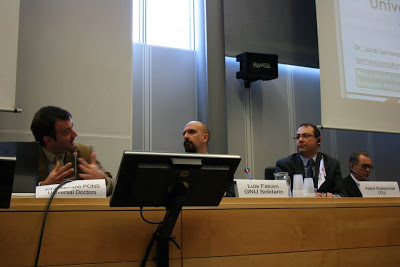
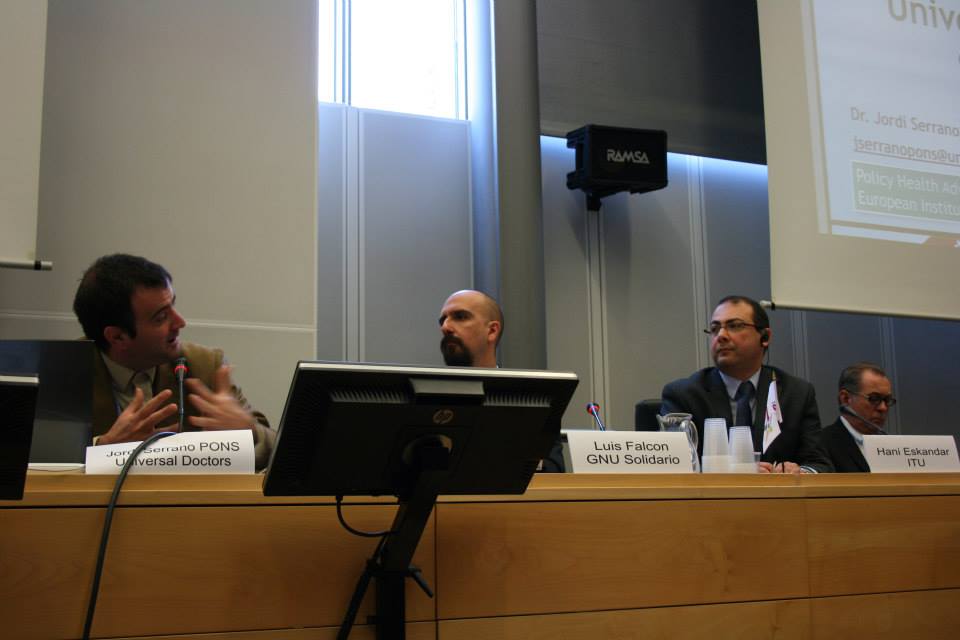
Dr. Jordi Serrano, Luis Falcon y Sr. Hani Eskandar

La informática medica es sólo una herramienta para optimizar el profesional de la salud, los centros de salud y las autoridades sanitarias. No es ciencia ficción y no debe reemplazar el factor humano. El rol del profesional de la salud, integrado con los pacientes, las familias y la sociedad es insustituible.

He tenido el honor de compartir el panel con la Dra. Véronique Thouvenot (ITU), el Dr. Misha Kay (WHO eHealth Unit), el Sr. Hani Eskandar (ITU), el Dr. Ousmane Ly (National Mali Telemedicine Agency), el Dr. Jordi Serrano Pons (UniversalDoctors) y el Prof. Peter Bruck ( World Summit Award).

Ponentes sesión sobre eSalud
Mi agradecimiento a la Unión Internacional de las Comunicaciones (IUT) y a la Organización Mundial de la Salud (WHO) por invitarme a un evento tan importante y por poner el Software Libre (FLOSS) en el orden del día. El Software Libre mantiene viva la Declaración Alma Ata y La Atención Primaria de la Salud, aportando equidad y universalidad. La Salud debería seguir siendo un derecho humano no negociable y, la comunidad del software libre, debería ser un elemento clave para lograr este objetivo.

Algunos enlaces:
WSIS Agenda
Fotos 2º día
About GNU Health

GNU Health es un Sistema Libre de Gestión Hospitalaria y de Información de la Salud con las siguientes funcionalidades:

  •     Expediente Médico Electrónico (EMR
  •     Sistema de Gestión Hospitalaria (HIS)
  •     Sistema de Información de Salud
En 2012 GNU Health ha sido galardonado como mejor Proyecto para Beneficio Social 2011 por la Free Software Foundation.
En 2013, GNU Health ha recibido los premios como  Software Libre mas revolucionario y software con mayor potencial de crecimiento por el  PortalProgramas.

GNU Health es un  Paquete Oficial GNU , y es parte de GNU Solidario. GNU Solidario en una ONG que entrega educación y salud con software libre a países en vía de desarrollo. GNU Health es un sistema de Gestión Hospitalaria y de Información de la Salud elegido por las Naciones Unidas y el International Institute of Global Health. GNU Solidario y la Universidad de Naciones Unidas, International Institute for Global Health han firmado un acuerdo para implementar y enseñar GNU Health a nivel mundial.

health.gnu.org

Reflections from GNU Health at WHO – ITU session WSIS 2013

26 Sunday May 2013

Posted by Luis Falcon in Uncategorized

≈ Leave a comment

Tags

developing countries, ehealth, free software, GNU Health, GNU solidario, Hospital Information System, ITU, phealth, Public Health, tryton, WHO, World Health Organization, WSIS

This month of May we had the immense privilege to be a guest speaker in the World Health Organization (WHO) and International Communication Union (ITU) session “ICT for Improving Information and Accountability for Women’s and Children’s Health” at the World Summit on the Information Society – WSIS 2013 Forum.

The title of the presentation was “GNU Health : Improving Children and Mothers Lives with Free Software“.  The presentation was on May 14th, and it was transmitted live over the Internet.

At WHO headquarters in Geneva
I keep thinking about the tremendous levels of maternal and child death, most of them from preventable diseases. This thoughts are the main drive to develop GNU Health, a tool to improve the health of millions of people in developing countries with Free Software. 
At the WSIS Forum 2013 inauguration session
GNU Health has at its heart Primary Care and the Alma Ata Declaration. We only change a letter from that declaration. To the original “Health for all“, we added the “e” to become “eHealth for all“.
Tily Martin and Miguel Falcon from GNU Solidario

In this sense, we fight to make health  – and eHealth – a public good. Governments should use Free Software as a way to achieve sustainable state policies in the field of public health. 
Luis Falcon during the session
It’s heartbreaking to see countries paying millions of dollars to corporations in freedom-denying software licenses. Think about putting that money to improve health promotion and disease prevention campaigns, or to improve the salaries of the health professionals; or to improve the infrastructure of many health centers, just to name some ideas.

Keeping along the Alma Ata Declaration and Primary Health Care, medical technology should be accessible, affordable and feasible. We don’t need expensive, science fiction hardware of software, we need affordable and effective tools in health care.
 
Tily Martin, Dr. Alberto Lazzero and Luis Falcon
In the talk I presented the GNU Health implementation case of a Public Hospital in Entre Rios, Argentina. GNU Health manages the city demographics, socioeconomics, families,  patient evaluations, laboratory, stock and pharmacy, hospitalizations, financial accounting, human resources and medical imaging, to name a few processes within the health center. The health center only had to invest in buying desktops in the health professional offices.
Dr. Jordi Serrano, Luis Falcon and Mr. Hani Eskandar

Health informatics is just a tool to optimize the health professional, health center and health authorities. It’s not science fiction and should never replace the human factor. The role of the health professional, integrated with the patient, families and society is irreplaceable.

I had the honor to share the panel with Dr. Véronique Thouvenot (ITU), Dr. Misha Kay (WHO eHealth Unit), Mr. Hani Eskandar (ITU), Dr Ousmane Ly (National Mali Telemedicine Agency), Dr. Jordi Serrano Pons (UniversalDoctors) and Prof. Peter Bruck ( World Summit Award). 

eHealth Session Panelists

 
My gratitude goes to WSIS and WHO for inviting me to such an important event, and for putting Free Software (FLOSS) in the agenda. Free Software care keeps alive the Alma Ata Declaration and Primary Health Care, providing equity and universality. Health must remain a non-negotiable human right, and the free software community should be a key component to achieve this goal.

Some links :

WSIS Agenda
Pictures from Day 2 sessions

About GNU Health
GNU Health is a Free Health and Hospital Information System that provides the following functionality: 

  • Health Information System (Demographics, Epidemiology)
  • Hospital Information System
  • Electronic Medical Record

GNU Health won the Best Project of Social Benefit from the Free Software Foundation, among other international awards.


GNU Health is an official GNU Package , and is part of GNU Solidario, an NGO that delivers health with free software. GNU Solidario and the United Nations University, International Institute for Global Health have signed an agreement to implement and to train Health professionals GNU Health around the world.

GNU Health was presented at the World Health Organization (WHO) and International Communication Union (ITU) session “ICT for Improving Information and Accountability for Women’s and Children’s Health” at the World Summit on the Information Society – WSIS 2013 Forum in Geneva.

Main site : health.gnu.org


GNU Health Conference at Medetel 2013

12 Friday Apr 2013

Posted by Luis Falcon in Uncategorized

≈ Leave a comment

Tags

ehealth, free software, gnu, GNU Health, GNU solidario, health, HMIS, Hospital Information System, Medetel 2013, phealth, tryton

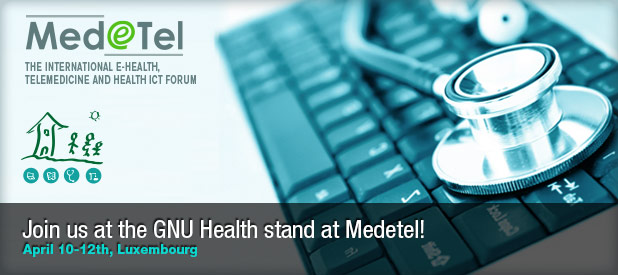
Don’t miss Sebastián Marró presentation. Today April 12th. at 11 AM in the Conference Room 4 – Medetel 2013 – 
“GNU Health: The Free Health & Hospital Information System”

GNU Health 1.8 is out, with Android support

21 Thursday Feb 2013

Posted by Luis Falcon in Uncategorized

≈ Leave a comment

Tags

AIDS, developing countries, free software, GNU Health, GNU solidario, Hospital Information System, Malaria, Public Health, tryton, tuberculosis, United Nations

From Luis Falcón blog:  
It’s been a couple of weeks since the release of GNU Health series 1.8, and we’re thrilled on the evolution of the system, and its adoption by the community.
This latest series is compatible with Tryton 2.6.x and has many improvements, in the core and reporting modules, among others. As usual, the migration from previous versions are included.

The other good news is that, being compatible with Tryton 2.6 allows the connection from mobile devices with the Android Operating System . 
Thanks to the great Tryton development framework, and to the fantastic job done by SCIL  in the development of the Android client for Tryton, GNU Health servers can now be accessed directly from your mobile device. 
 
You can find the Android client on Google Play . For the development process, check the SCIL page .

There are more good news on the way. The web client is also around the corner, and we will have 3 different ways to connect to GNU Health. From the standard GTK interface, the Android client, or your web browser.

Make sure you upgrade your database to the latest GNU Health version. The upgrade scripts and the instructions are always incorporated in the new version. The upgrade process is an integral part of GNU Health and, of course, it’s completely free.
e-Health for all !

About GNU Health

GNU Health is a free Health and Hospital Information System that provides the following functionality : 

  •     Electronic Medical Record (EMR)
  •     Hospital Information System (HIS)
  •     Health Information System (Epidemiology)


GNU Health has been awarded the Best Project of Social Benefit from the Free Software Foundation in 2012. 

In 2013, GNU Health received the awards for  most revolutionary Free Software and software with the largest potential from PortalProgramas.

GNU Health is an  official GNU Package , chosen by Richard Stallman, and is part of GNU Solidario. GNU Solidario is a NGO that delivers education and health to emerging economies with free software. GNU Health is the Hospital Information System chosen by the United Nations International Institute of Global Health.  GNU Solidario and the United Nations University, International Institute for Global Health have signed an agreement to implement and to train GNU Health globally.

Richard Stallman in Argentina

11 Monday Jun 2012

Posted by Luis Falcon in Uncategorized

≈ Leave a comment

Tags

argentina, free software, fsf, gnu, GNU Health, GNU solidario, Hospital Information System, luis falcon, richard stallman, Via Libre

As the “Free Software World” knows, Dr. Richard Stallman visited Argentina last week.
Dr. Stallman
Thanks to the great work of Fundación Via Libre and the Centro de Estudiantes “Nuevo Espacio”, Stallman could come to Argentina one more time !
So, as planned, Dr. Stallman got to Argentina for the last time and started his agenda. He first went to Rio Negro where he provided support for the initiative of the provincial government to pass a Law of Free Software. 

Then, on Friday, June 8th he gave an excellent conference at the Facultad de Ciencias Económicas of the Universidad de Buenos Aires (UBA). There were around 500 people present and, according to many people, it was one of the best conference Dr. Stallman has given. 
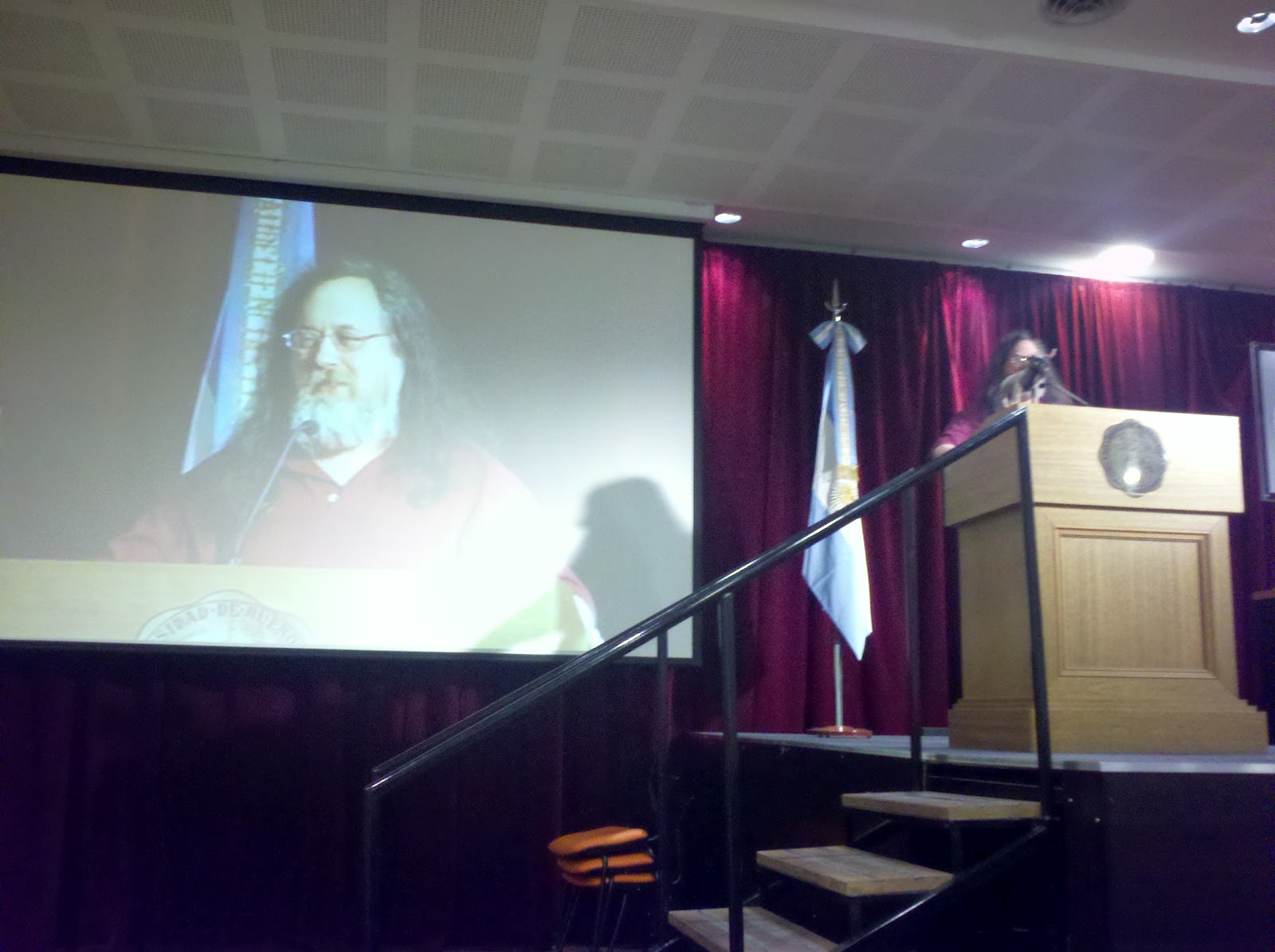
During the lecture Luis Falcón, of GNU Solidario, was invited by Stallman to talk about GNU Health: The Free Health and Hospital Information System. We really want to to thank Mr. Stallman for this opportunity and for the support to the GNU Health project. 
Luis Falcón – GNU Solidario –
Unfortunately, a night that was supposed to be remembered forever as the last time of Stallman in Argentina, ended up in the worst way. While many people were surrounding Mr. Stallman to take pictures and buy some merchandising, his bag was stolen. He was robbed of his computer, passport, money, medicines … (wikinoticias).
During the weekend we had the opportunity to spend some time with him and it was nice to have a dinner with talks and jokes (Mr. Stallman has a great sense of humor, even in Spanish !).

We wish him good luck and a safe trip back home !
If anyone has news about the stolen articles send a mail to: info@vialibre.org.ar

GNU Health 1.6 series released

04 Monday Jun 2012

Posted by Luis Falcon in Uncategorized

≈ Leave a comment

Tags

Free Software Foundation, gnu, GNU Health, gynecology, health promotion, Hospital Information System, tuberculosis, WHO

From Luis Falcon`s blog:

I’m proud to announce GNU Health 1.6 series !

This series brings a lot of exciting features, both from the technical and functional point of views.
On the technical side, the most important one is the compatibility with Tryton 2.4, and the demo database, so you can test it with data.

On the functional side, improvements in the gynecology module, especially in terms of screening (mammography, PAP tests, colposcopies… ) and history taking.
There has been major changes in the services and billing functionality, making easy the tracking of all the services done to a patient, and what would be subject to invoicing.

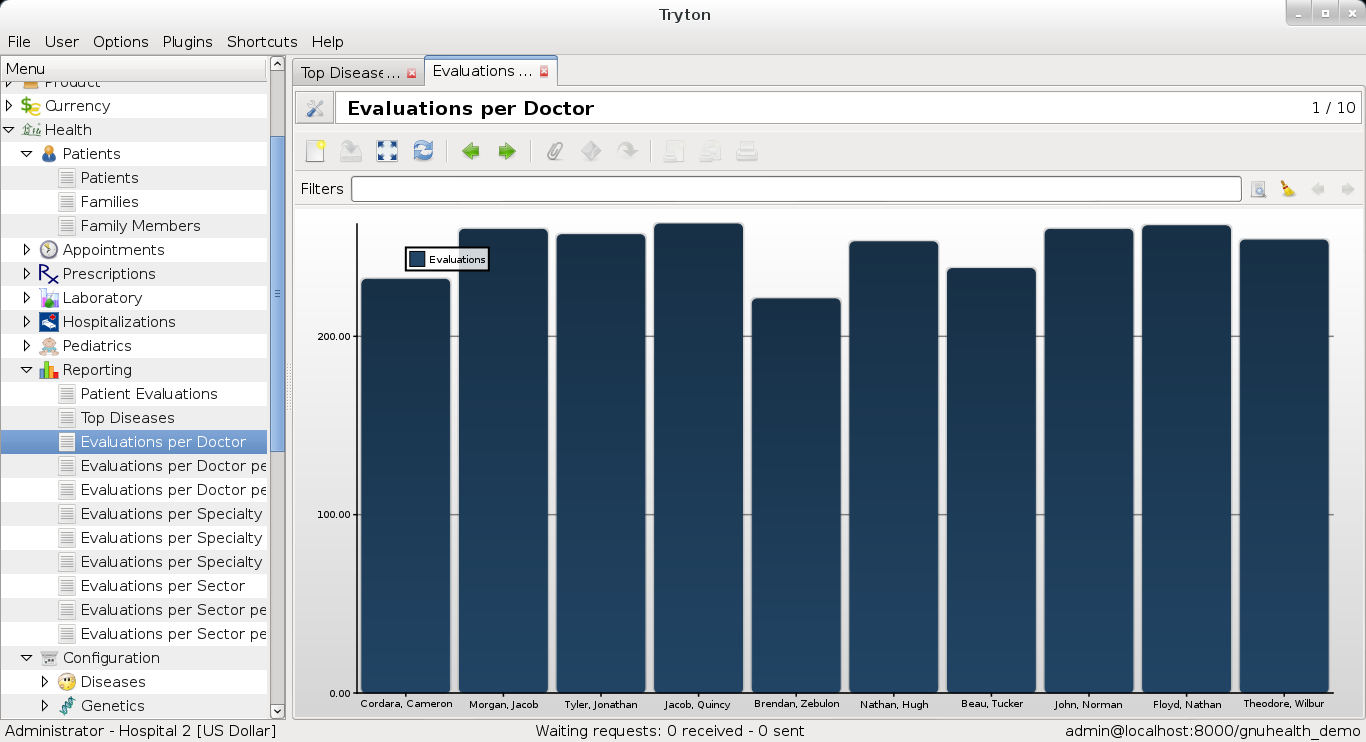
Evaluations per doctor chart in GNU Health

Some of the features in the 1.6 series, in brief :
  • Compatible with Tryton 2.4
  • Full Patient clinical history reporting in LibreOffice
  • Included demo database with over 500 patients 
  • Realtime charts and statistics graphics
  • Automatic  doctor assignment in patient evaluations
  • Add Gynecological Screening History – Mammography, PAP and colposcopy
  • Improve patient evaluation , differential diagnosis and secondary conditions
  • Add disease groups, very useful for epidemiology
  • Better patient and contact tracking
  • Initial Tuberculosis lab tests, included in the MDG (Millennium Development Goal # 6 ) module.
We have also included the Health services module,
Health Services form in GNU Healt
This new module allows to group all the services done to a patient, in either ambulatory or inpatient settings. The module will give the health center the possibility to also invoice selected services to a specific party (patient, insurance company .. ). Since the services are linked to products, the health center will keep a detailed record of the drugs and consumables used. They will also be able to relate the lab orders.

Thank you to all of you who have contributed to this new version of GNU Health. Thanks to the Tryton community for the great Tryton 2.4; to my colleagues from Thymbra for developing the graphics / reporting module (Sebastián), working on the documenation and testing (Cristina and Selene) and, of course, to all the GNU Health and GNU community for adopting and hosting our project !

About GNU Health

GNU Health is a free Health and Hospital Information System that provides the following functionality : 

  •     Electronic Medical Record (EMR)
  •     Hospital Information System (HIS)
  •     Health Information System

GNU Health has been awarded the Best Project of Social Benefit from the Free Software Foundation in 2012.

GNU Health is an official GNU Package , chosen by Richard Stallman, and is part of GNU Solidario. GNU Solidario is a NGO that delivers education and health to emerging economies with free software.

GNU Health is the Hospital Information System chosen by the United Nations International Institute of Global Health. 

Main site : health.gnu.org

Governments hosting GNU Health through their portals :

    European Commission (EU) , JoinUp

    Brazil: Portal do Software Público Brasileiro (SPB)

GNU Solidario presenta GNU Health en Perú

23 Monday Apr 2012

Posted by Luis Falcon in Uncategorized

≈ Leave a comment

Tags

e-prescription, EMR, gnu, GNU Health, HMIS, Hospital Information System, Perú, Salud Pública

Por Sebastián Marró:
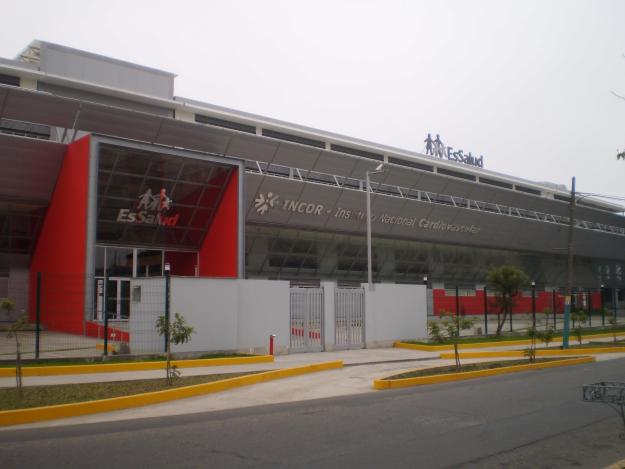
El lunes pasado regresé de Perú, donde fuimos invitados por EsSalud (Dr. Alvaro Vidal Rivadeneyra – Presidente Ejecutivo) en conjunto con la Oficina Nacional de Gobierno Electrónico e Informática (ONGEI) para presentar GNU Health, el sistema Libre de Gestión Hospitalaria y de Salud, en el marco del Encuentro Internacional “Tecnologías de Información, como Herramienta en la Salud e Inclusión Social 2012” realizado en las instalaciones del Instituto Nacional del Corazón (INCOR), en Lima.
  
El Seguro Social de Salud o EsSalud es la institución peruana de la seguridad social en salud. Cuenta con hospitales generales, policlínicos y establecimientos especializados de salud, así como Centros del Adulto Mayor y Centros Especializados de Rehabilitación Profesional. 
Fueron un total de cuatro los días que pasé en Lima. El día jueves fue la inauguración del Evento. Por la mañana se habló de la problemática actual que está sufriendo la institución EsSalud en materia de soluciones TI, mientras que por la tarde tuve la oportunidad de ver presentaciones de casos exitosos en el ámbito internacional entre las cuales quiero destacar la presentación del software para laboratorios Bika Health, a cargo de Johannes Nicolaas Smit (Lemoene) de Sudáfrica y el Dr. Christoph Heinrich Larsen de Vietnam y la presentación de InVesalius, software para la reconstrucción de estructuras del cuerpo humano, a cargo de Jorge da Silva de Brasil.
 
 
El día viernes tuve la oportunidad de dar la primer exposición sobre GNU Health para personal de EsSalud: Alta Dirección, gerentes, jefes de las Oficinas Centrales, personal de Salud e Informática, así como los responsables del conjunto de las redes asistenciales. Como invitados también se encontraban funcionarios del MINSA, SUNASA, MEF, SUNAT, centros asistenciales de la policía y fuerzas armadas, hospitales de la solidaridad.
 
 
Por la tarde nos dividimos en grupos de trabajo donde pudimos entrar en contacto directo con la problemática de EsSalud y contestar diversas inquietudes que los profesionales de la salud e informática nos fueron presentando.

El sábado al medio día pude dar la segunda exposición sobre GNU Health, en este caso el evento estaba abierto al público en general, donde puede explicar las bondades de tener la libertad de usar y parametrizar GNU Health con el fin de adecuarlo a sus necesidades. Tuve el agrado de conocer a Jefes Informáticos de las distintas redes asistenciales del Perú, con los que pude profundizar en algunos aspectos de GNU Health y con los que espero poder continuar en contacto
 
El día domingo pude aprovechar para pasear y conocer la bonita ciudad de Lima junto con el Dr. Christoph Larsen y Lemoene.
 
 
Agradezco en nombre de GNU Solidario a las autoridades de EsSalud por su invitación y hospitalidad, a Alfonso de la Guarda por gestionar nuestra participación en este evento y a Cecilia Contreras por su ayuda con todos los temas logísticos y hacerme sentir tan bien!


Más información: info@gnusolidario.org

GNU Health wins FSF Project of Social Benefit

02 Monday Apr 2012

Posted by Luis Falcon in GNU Health, GNU solidario, Public Health

≈ Leave a comment

Tags

award, developing countries, ehealth, free software, Free Software Foundation, fsf, GNU Health, GNU solidario, Hospital Information System, Public Health, UMass

Just got back to Buenos Aires after a 10 days in the United States and El Salvador, and finally got some time to write about the award, what it means to GNU Solidario and to the community at large.
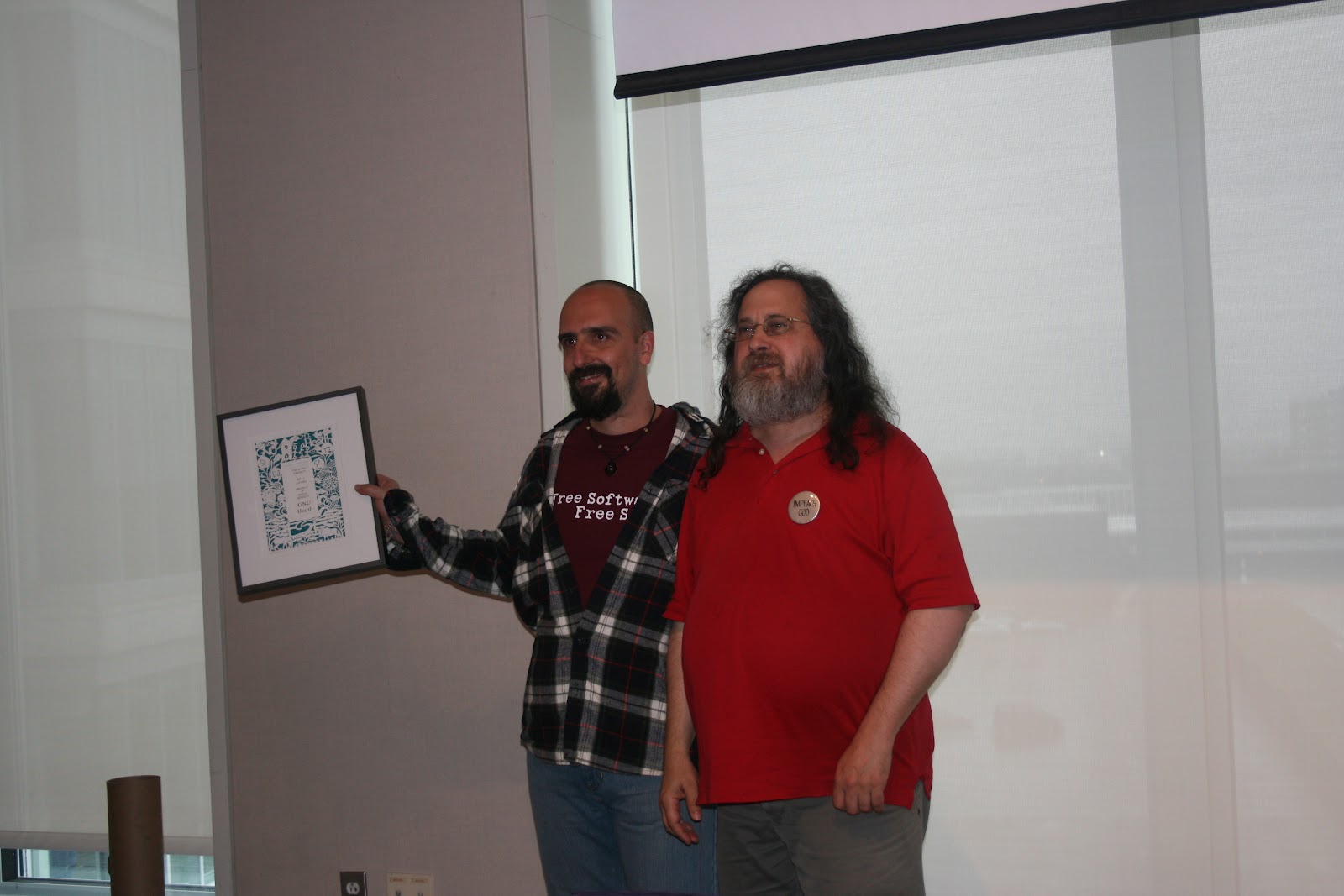
The FSF’s ceremony took place at the University of Massachusetts, Boston (UMass) on Sunday March 25th, during the LibrePlanet 2012 conference. On the ceremony, there were two awards :
  • Award for the Advancement of Free Software:Yukihiro Matsumoto, creator of the Ruby Programming Language. Congratulations Matz !
  • Award for the Project of Social Benefit : GNU Health
Richard Stallman and Luis Falcon
As stated by the FSF, the Award for Projects of Social Benefit is presented to the project or team responsible for applying free software, or the ideas of the free software movement, in a project that intentionally and significantly benefits society in other aspects of life. This award stresses the use of free software in the service of humanity.

GNU Health won award for Project of Social Benefit 2011
I want to thank the committee for choosing GNU Health : Suresh Ramasubramanian, Peter H. Salus, Wietse Venema, Raj Mathur, Hong Feng, Andrew Tridgell, Jonas Oberg, Vernor Vinge, Richard Stallman, Fernanda G. Weiden, Harald Welte, and Rob Savoyes.

Luis Falcon holding the award and the mascot


We take this award with great pride, but also with great responsibility. We share this award with novel previous winners  Wikipedia, Creative Commons, Internet Archives, Groklaw, Tor and Sahana Disaster Management System .

I see Free Software as social activism. GNU Health goal is to improve the lives of the underprivileged by means of Free Software.  We deliver a Free Health and Hospital Information System to health centers all around the world. Because is Free (Freedom), the software belongs to them. They can modify it, improve it, and localize it to their needs ! This is the Free Software philosophy.

GNU Health provides the basis for sustainable and universal medicine, no matter the economical status of the health center or the patient. After all, Health is a non-negotiable human right and never should belong to the greedy corporations. Health is a public good, and so it should be health informatics.

Yukihiro Matsumoto “Matz” and Luis Falcon

I want to thank the Free Software Foundation and his creator, Richard Stallman, for creating the environment for social justice and equity. 
Thank you to the Free Software community : Python, Postgresql, Tryton, GNU/Linux, GnuPG and Wikimedia foundation are just some of the building blocks for GNU Health. Without a free software community, GNU Health wouldn’t exist.
Thank you to the governments adopting Free Software as a Public good.
Thank you to the community, to all of you who contribute your time and talent to improve GNU Health !
Finally, I want to dedicate this award to the men and women who anonymously give their lives to help the underprivileged. You are an example for all of us !
For more information, please check the official announcement at the Free Software Foundation  : 
http://www.fsf.org/news/2011-free-software-awards-announced
About GNU Health

GNU Health is a free Health and Hospital Information System that provides the following functionality : 

  •     Electronic Medical Record (EMR)
  •     Hospital Information System (HIS)
  •     Health Information System

GNU Health is an official GNU Package , chosen by Richard Stallman, and is part of GNU Solidario. GNU Solidario is a NGO that delivers education and health to emerging economies with free software.

GNU Health is the Hospital Information System chosen by the United Nations International Institute of Global Health. 

Main site : health.gnu.org

Governments hosting GNU Health through their portals :

    European Commission (EU) , JoinUp

    Brazil: Portal do Software Público Brasileiro (SPB)


GNU Health Decision Support on Prescription Writing

23 Thursday Feb 2012

Posted by Luis Falcon in GNU Health

≈ Leave a comment

Tags

e-prescription, ehealth, emerging economies, FDA, free software, gnu, GNU Health, GPL, Hospital Information System, pregnancy, prescription, UNU

In this entry I will briefly talk about how GNU Health can help the professional in making the best decision, and how to minimize mistakes.
I will focus in prescription writing and how we’re incorporating DS (Decision Support) to GNU Health.
GNU Health uses the WHO (World Health Organization) essential list of medicines by default, so you already have a very nice and updated set for your daily practice.
The medicament model incorporates the pregnancy category. In this case, we have opted for the FDA pregnancy categories, but you can configure GNU Health to use another categorization system.
In the next screenshot, you can see a list of medicines, with an specific color, that specifies the pregnancy category. That visual aid quickly differentiate those medicaments to avoid use in pregnancy (all in categories D and – especially category X ), from those that will be generally safe to use (such as those in categories A and B ).
 
Color encoded WHO list of essential medicines by FDA pregnancy category
So, from that very starting point, you have GNU Health assisting you visually to choose the right drug. 
After you have finished the prescription writing process, GNU Health does different checks in relation to the patient you are writing the prescription.
In its simplest form, let’s check the next example. GNU Health checks the patient sex and age, and determines the risks associated to that patient. In this case, the patient belongs to a potential childbearing / fertile group. So, GNU Health will set a verification flag and will remind the health professional to ask the patient basic but very important questions about the patient status, such as :
– Is she pregnant
– Is the patient planning to become pregnant
– In the case of pregnancy, in which trimester is she in
In other words, GNU Health will stop us from making the prescription until we have verified that what we are prescribing is an educated and thoughtful decision, the best possible for our patient.
By the way GNU Health keeps record of the gynecological and obstetric status of the patient, but this might be the first encounter or her medical record might be in another center that has some dark privative software that does not share the information 😉
GNU Health prescription verification process in specific patients
Of course, the ultimate decision will always be on the doctor. This type of Decision support we aim to minimize common pitfalls due to fatigue, inexperience, etcetera that can jeopardize the wellbeing of the patient.

Many thanks to Dr. Christoph Larsen and Andrew Gledhill (NHS) that have helped me in the process.

We will definitely enhance the Decision Support from GNU Health, such as in the clinical context, always keeping simplicity and just as a guiding / aiding tool for the professional.

About GNU Health

GNU Health is a free Health and Hospital Information System that provides the following functionality :

  •     Electronic Medical Record (EMR)
  •     Hospital Information System (HIS)
  •     Health Information System

GNU Health is an official GNU Package , chosen by Richard Stallman, and is part of GNU Solidario. GNU Solidario is a NGO that delivers education and health to emerging economies with free software.

GNU Health is the Hospital Information System chosen by the United Nations International Institute of Global Health.

Main site : health.gnu.org

Governments hosting GNU Health through their portals :

    European Commission (EU) , JoinUp

    Brazil: Portal do Software Público Brasileiro (SPB)

GNU Health Reporting

05 Sunday Feb 2012

Posted by Luis Falcon in GNU Health, GNU solidario, HMIS

≈ Leave a comment

Tags

ehealth, emerging economies, free software, gnu, GNU Health, GNU solidario, HMIS, Hospital Information System, LibreOffice, QR code, relatorio, reporting, tryton

In the last blog I talked about the QR codes integration in GNU Health.
Today I am very happy to  show a couple of reports from GNU Health, done in the Tryton (Relatorio and Libre Office) framework.
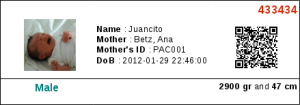
In GNU Health you can generate complex dynamic reports. In the next two examples, the patient and newborn information is displayed. Some of the information is encoded in the QR code.

Patient ID card report on GNU Health

Tryton allows you to create dynamic LibreOffice reports, and these two examples show how we can embed functions, real-time graphics or change the font color depending on the gender of the patient, to name a few capabilities of this great environment.
Newborn wristband Identification, with all the information encoded in QR

We show again how Free Software (Tryton, Libre Office, Python, Postgresql, GNU/Linux, … ) allow us doing anything we need. So, please use Free software. It’s ethical.  

We fight for equity in Health care, and one way of doing so is by using Free Software !

About GNU Health

GNU Health is a free Health and Hospital Information System that provides the following functionality :

  •     Electronic Medical Record (EMR)
  •     Hospital Information System (HIS)
  •     Health Information System

GNU Health is an official GNU Package , chosen by Richard Stallman, and is part of GNU Solidario. GNU Solidario is a NGO that delivers education and health to emerging economies with free software.

GNU Health is the Hospital Information System chosen by the United Nations International Institute of Global Health.

Main site : health.gnu.org

Governments hosting GNU Health through their portals :

    European Commission (EU) , JoinUp

    Brazil: Portal do Software Público Brasileiro (SPB)

← Older posts
Newer posts →

Recent Posts

  • Gracias, India
  • Parallel and distributed computing in GNU Health
  • El cambio de horario es un atentado contra la salud. Rechazarlo es la mejor medicina
  • Tu finca, su infierno
  • La Cátedra de Animales y Sociedad de la URJC: Un referente de empatía y respeto hacia los animales.

Archives

  • September 2025
  • May 2025
  • March 2025
  • February 2025
  • May 2024
  • July 2023
  • March 2023
  • February 2023
  • January 2023
  • October 2022
  • August 2022
  • April 2022
  • February 2022
  • September 2021
  • August 2021
  • July 2021
  • June 2021
  • March 2021
  • December 2020
  • September 2020
  • July 2020
  • May 2020
  • March 2020
  • February 2020
  • November 2019
  • October 2019
  • June 2019
  • April 2019
  • May 2018
  • November 2017
  • October 2017
  • June 2017
  • May 2017
  • April 2017
  • March 2017
  • February 2017
  • January 2017
  • December 2016
  • November 2016
  • October 2016
  • September 2016
  • August 2016
  • July 2016
  • June 2016
  • May 2016
  • April 2016
  • March 2016
  • February 2016
  • January 2016
  • November 2015
  • October 2015
  • September 2015
  • August 2015
  • July 2015
  • May 2015
  • March 2015
  • February 2015
  • January 2015
  • December 2014
  • October 2014
  • September 2014
  • July 2014
  • June 2014
  • May 2014
  • April 2014
  • March 2014
  • December 2013
  • November 2013
  • October 2013
  • September 2013
  • August 2013
  • July 2013
  • June 2013
  • May 2013
  • April 2013
  • March 2013
  • February 2013
  • January 2013
  • December 2012
  • November 2012
  • October 2012
  • September 2012
  • August 2012
  • July 2012
  • June 2012
  • May 2012
  • April 2012
  • March 2012
  • February 2012
  • January 2012
  • December 2011
  • November 2011
  • October 2011
  • September 2011
  • August 2011
  • July 2011
  • June 2011
  • May 2011
  • April 2011
  • March 2011
  • February 2011
  • January 2011
  • December 2010
  • November 2010
  • October 2010
  • September 2010
  • August 2010
  • July 2010
  • June 2010
  • May 2010
  • April 2010
  • March 2010
  • February 2010
  • January 2010
  • December 2009
  • November 2009
  • October 2009
  • September 2009
  • August 2009
  • July 2009
  • June 2009
  • May 2009
  • February 2009
  • November 2008
  • October 2008
  • September 2008
  • December 2007
  • October 2006

Categories

  • #FHIR
  • animal liberation
  • animal rights
  • embedded
  • events
  • gnu
  • GNU Health
  • GNU solidario
  • HMIS
  • KDE
  • Libre Software
  • LIMS
  • medical
  • MyGNUHealth
  • Public Health
  • thalamus
  • tryton
  • Uncategorized

Meta

  • Create account
  • Log in
  • Entries feed
  • Comments feed
  • WordPress.com

Blog at WordPress.com.

  • Subscribe Subscribed
    • MeanMicio
    • Already have a WordPress.com account? Log in now.
    • MeanMicio
    • Subscribe Subscribed
    • Sign up
    • Log in
    • Report this content
    • View site in Reader
    • Manage subscriptions
    • Collapse this bar