GNU Health at FLISOL 2013 – Interview by Canal Seis

Tags

, , , , , , ,

We would like to thank once again all the people involved in the organization of this great event. It was a pleasure and an honor to share this moment with all of you.
It was a great opportunity to show how it is possible to deliver e-Health and Education with Free Software !
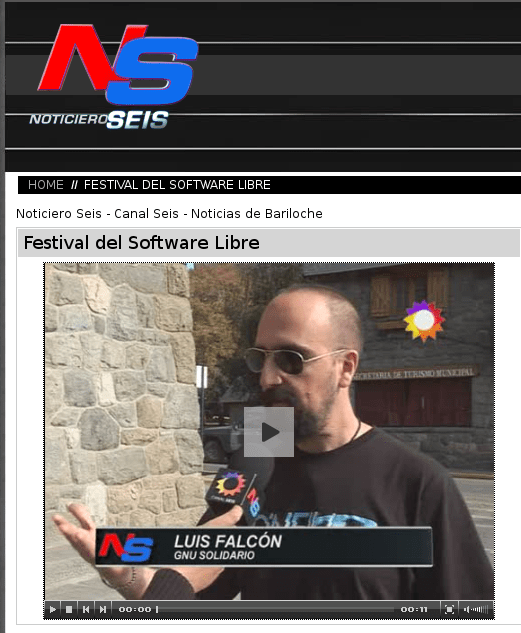
We’ll leave you with a video !

WHO Essential Medicines – OMS Medicinas Esenciales

Tags

, , , , , , , , , , ,

WHO Essential Medicines will be a new module from GNU Health 2.0.
Although the updated list of WHO essential medicines has been in GNU Health for quite a while, we have decided to create a module for itself, this will give us more flexibility and modularity.

Welcome health_who_essential_medicines ! More information on this at the WHO site http://www.who.int/topics/essential_medicines/en/

Medicamentos Esenciales de la Organización Mundial de la Salud (OMS), será un nuevo módulo de la version 2.0 de GNU Health.
Aunque la lista actualizada de los medicamentos esenciales de la OMS ha estado en GNU Health durante bastante tiempo, hemos decidido crear un módulo especifico, esto nos dará más flexibilidad y modularidad.

Bienvenido health_who_essential_medicines! Mas información en el sito de la OMS: http://www.who.int/topics/essential_medicines/es/index.html


World Summit on the Information Society

Tags

, , , , , ,

We are extremely proud to announce our presence at the World Summit on the Information Society on May 14th. 2013, in Geneva.

Luis Falcón will present GNU Health: Improving Children and Mothers lives with Free Software. A new approach in Primary Care.” at the Action Line C7 Interactive Facilitation Meeting on eHealth: ICT for Improving Information and Accountability for Women’s and Children’s Health. 
This session will feature some of the innovative ICT applications for Maternal and Child Health and highlight efforts of national and international organizations to foster the use of ICT to better implement the recommendations of the Commission on Information and Accountability for Women’s and Children’s Health.
We hope to see you in Geneva !
 

GNU Health 2.0 – stable version

Tags

, , , , , , , , ,

From Luis Falcón:

I’m happy to announce the scheduled release for the next stable version of GNU Health 2.0

We should be able to release it on May 12th, 2013.

The main changes will be :

  • Compatibility with upcoming Tryton 2.8
  • Initial inclusion of Neglected Tropical Diseases series (health_ntd series) starting with Chagas disease (health_ntd_chagas)
  • Bug fixes and enhancements of current modules
  • Packages for Archlinux and Parabola GNU/Linux

We will upload the RC to the community server in 10 days or so from now.

Let’s work in parallel on the documentation and translation !

Más noticias de GNU Health en ALPI

Tags

, , , , , , , ,

Queremos compartir con todos ustedes esta gran noticia (desde la página web de ALPI)

Doná una computadora a ALPI

Con la donación de 30 computadoras ALPI podrá maximizar su desempeño, seguridad y disponibilidad dentro del campo de la “Informática Médica” a través de la  implementación del Software Libre por el sistema de Gestión Hospitalaria y de Información de Salud (GNU Health, por sus en inglés).  Así podremos continuar respondiendo a las necesidades de las personas con menos recursos.
Si recién compraste un nuevo equipo y buscar reciclar tu vieja computadora que todavía funciona, puedes donarla a ALPI, donde será usada para facilitar la atención de las personas más necesitadas.
Según estableció nuestro Director Ejecutivo, Jorge Giana, en la Conferencia Nacional de E-Salud, este proyecto es muy ambicioso ya que no hay en la argentina un software de gestión confiable como este (GNU Health). A través de la implementación de este sistema los hospitales de la Argentina podrán tener una herramienta de costo cero, adaptada y probada por el equipo de informática del Hospital Italiano, uno de los pocos lugares que cuenta con una residencia de informática médica.”      
A través de GNU Health la institución cambia la forma actual de administrar las historias clínicas por un procedimiento digitalizado.
Cada médico especialista, así como  otros sectores de asistencia, podrán visualizar en forma automática las historias clínicas de los pacientes del Centro de Internación y de Atención Ambulatoria. Este procedimiento posibilitará un ahorro en tiempo de búsqueda de información, además de un orden mayor al guardar la documentación de cada paciente digitalmente. 
Este proyecto está a cargo de Thymbra, empresa especializada en este tipo de sistemas de gestión de información.
Para hacer tu donación puedes comunicarte con el 4821-1200 o a través del mail desarrollo@alpi.org.ar.


GNU Health at Med-e-Tel 2013

Tags

, , , , , , , , ,

We are proud to invite  you GNU Health stand at Med-e-Tel 2013: the official event of the International Society for Telemedicine & eHealth (ISfTeH).
Through this event, the ISfTeH facilitates the international dissemination of knowledge and experience in Telemedicine and eHealth in order to provide access to recognized experts in the field worldwide. That’s why GNu Health has been invited to participate as The Free Health and Hospital Information System.

Med-e-Tel focuses on e-Health and telemedicine applications and a wide range of other medical ICT applications and on the convergence of information and communication technology with medical applications, which lead to higher quality of care, cost reductions, workflow efficiency, and widespread availability of healthcare services.

Do not forget to check the list of Med-e-Tel 2013 sponsors and exhibitors, it will be a very productive event.

Med-e-Tel 2013 will allow you to see and test hands-on a number of Telemedicine and eHealth products and solutions from companies around the world. The event will also feature several international organizations and institutions who are active in Telemedicine/eHealth research, implementation and funding or who create global networking opportunities across geographical and professional boundaries.

We’ll see you all in Luxembourg !

Success of GNU Health goes beyond free software

Tags

, , , , , , ,

Please find below Luis Falcón’s interview about GNU Health in opensource.com

In 2006, Luis Falcón founded GNU Health, a free health information system that recently recieved the “Best Project of Social Benefit” award given by the Free Software Foundation.
GNU Solidario is the non-profit NGO behind GNU Health, started as a free software project for Primary Care facilities in rural areas and developing countries. Since then, it has evolved into a full Hospital and Health Information System used by the United Nations, public hospitals and Ministries of Health (such as in Entre Rios, Argentina), and private institutions around the globe.
GNU Health/Solidario and the United Nations International Institute for Global Health—UNU IIGH—signed an agreement in 2011 to train health professionals around the world on the system, as a way of promoting free software in public health, especially in emerging economies. Since then, both organizations have been cooperating and expanding their network of partners to deliver health in a universal way; which, also works towards the UN’s Millenium Development Goals.
Q: What are the top 3 ways that GNU Health is better than a proprietary system in use now?
A: GNU Health is an official GNU program and community-based project, so…
Administrators and providers can download GNU Health for free, study it, then adapt it to their needs.
There’s no vendor lock-in, because there’s no vendor. There are no hidden costs or upgrade scripts. Everyone will always be able to upgrade to the latest version for free.
There is an international community of support around GNU Health. We have community GNU Health demo server, documentation at WikiBooks, IRC channels, mailing lists, bug tracking systems, and a development environment.
Q: How does it go beyond cost?
A: Freedom and ethics.
GNU Health evolves from the talent, feedback, contributions of a constantly growing community.There are already academic institutions, like the United Nations and its International Institute for Global Health, teaching GNU Health to health professionals around the world. GNU Solidario, the non-profit organization behind GNU Health, delivers health and education with free software. We work with the United Nations and other institutions to provide primary care and preventive medicine and other of the MDG (Millenium Development Goals). For instance, we have a GNU Health module specific to MDG6, helping tof ight Malaria, HIV/AIDS and Tuberculosis. GNU Solidario also hosts the International Workshop on eHealth in Emerging Economies, a yearly conference focused on free software on eHealth, and how it can help organizations to improve the lives of their people. We have guests and participants from Doctors without Borders, United Nations, UNESCO, Red Cross, academic institutions, and health ministries. As you can see, it goes far beyond free of cost.
Q: Does GNU Health work in tandem with existing health systems or does it replace them?
A: It can do both.
In terms of health center management, GNU Health combines and integrates patient information from their electronic medical records (demographics, evaluations, medical history, labs, etc.) with the health center’s processes (accounting, human resources, stock, supply chain management, etc.). Any uncoupled systems (accounting, HR, EMR, SCM, etc.) can be replaced in order to optimize the resources and processes into one system.
GNU Health can also interoperate with other free software healthcare projects. For example, GNU Health can store patient medical images (MRIs, Xrays, CT, etc.) locally or connect directly to a PACS server using DICOM viewers like Ginkgo or Aeskulap. Interoperability in a hospital environment is a must and free software provides the tools to achieve more.
Q: Have most health administrators been eager or reluctant to implement an open source health system?
A: We have implemented GNU Health in both public hospitals and private institutions.
And they love the idea of having a system that belongs to them. GNU Health is a community-based project, so they are not tied to a software vendor; there are no licenses, hidden costs, or vendor lock-ins.
Q: Do providers have to buy new equipment and hire IT professionals to implement GNU Health?
A: It depends on the size and complexity of the center.
Hospital Information Systems deal with many aspects (accounting, stock, clinical records, suppliers, epidemiology, laboratory, pharmacy, security and access control, etc.). So, it’s no surprise that a well planned and designed project implemented by a well-trained local team will produce a high-quality product with a high level of sustainability.
Q: Why do you feel GNU Health benefits more patients, caregivers, and doctors than current systems?
A: In addition to being free software…
The system focuses on the human factor and takes a holistic approach to the patient—making concepts like health promotion, disease prevention, family medicine, and social determinants of disease top priorities. From a technical point of view, scalability and adaptability are key. Today there are over 20 different language and localization teams, making it easy for anyone to use GNU Health in their region.
Q: Does GNU Health provide high scalability?
A: GNU Health provides solutions for small offices and large hospitals.
The system’s modular design allows them to adapt its functionality to the complexity of their health center. GNU Health runs on top of the fantastic PostgreSQL database and we can implement it in a centralized or distributed environment. Plus, GNUHealth makes use of Python and Tryton frameworks; both are very scalable.
Q: Do you suggest other open source solutions to health providers and centers?
A: Absolutely.
Systems like Aeskulap or Ginkgo are excellent DICOM viewers. Bika Labs is a LIMS that can connect directly to GNU Health laboratory module. Tryton provides a robust and scalable framework to build enterprise solutions.
Q: What issues do we all need to better understand about our health?
A: Health is an issue for us all, whether we think about it much or not.
I encourage people to ask their politicians to adopt free software in the healthcare sector, because health is a public good. And thus, all health information systems should be based on free software. Public health and propietary software are antagonistic.
We, as individuals, should demand free software in our public administrations. And health professionals should know about free software and how it can help them, their patients, and their caregivers. Next time you go to the doctor, please tell her or him about the benefits of free software and write them a prescription for health.gnu.org!

GNU Health 1.8 is out, with Android support

Tags

, , , , , , , , , ,

From Luis Falcón blog:  
It’s been a couple of weeks since the release of GNU Health series 1.8, and we’re thrilled on the evolution of the system, and its adoption by the community.
This latest series is compatible with Tryton 2.6.x and has many improvements, in the core and reporting modules, among others. As usual, the migration from previous versions are included.

The other good news is that, being compatible with Tryton 2.6 allows the connection from mobile devices with the Android Operating System . 
Thanks to the great Tryton development framework, and to the fantastic job done by SCIL  in the development of the Android client for Tryton, GNU Health servers can now be accessed directly from your mobile device. 
You can find the Android client on Google Play . For the development process, check the SCIL page .

There are more good news on the way. The web client is also around the corner, and we will have 3 different ways to connect to GNU Health. From the standard GTK interface, the Android client, or your web browser.

Make sure you upgrade your database to the latest GNU Health version. The upgrade scripts and the instructions are always incorporated in the new version. The upgrade process is an integral part of GNU Health and, of course, it’s completely free.
e-Health for all !

About GNU Health

GNU Health is a free Health and Hospital Information System that provides the following functionality : 

  •     Electronic Medical Record (EMR)
  •     Hospital Information System (HIS)
  •     Health Information System (Epidemiology)


GNU Health has been awarded the Best Project of Social Benefit from the Free Software Foundation in 2012. 

In 2013, GNU Health received the awards for  most revolutionary Free Software and software with the largest potential from PortalProgramas.

GNU Health is an  official GNU Package , chosen by Richard Stallman, and is part of GNU Solidario. GNU Solidario is a NGO that delivers education and health to emerging economies with free software. GNU Health is the Hospital Information System chosen by the United Nations International Institute of Global Health.  GNU Solidario and the United Nations University, International Institute for Global Health have signed an agreement to implement and to train GNU Health globally.

Richard Stallman at IWEEE 2013 . Webm format

Tags

, , , , , , , , , ,

Just wanted to share Richard Stallman’s interview at the GNU Solidario‘s International Workshop on e-Health in Emerging EconomiesIWEEE 2013 -. (in Spanish)
As Richard and the Free Software community request, the following video is in encoded in WebM format.

The video in webm format can also be downloaded here  : http://www.iweee.org/presentations/2013-las_palmas/IWEEE_2013_stallman.webm
IWEEE is the annual GNU Solidario workshop that focuses in Free Software solutions for the health care sector, especially for developing countries

This year we had speakers from :

  • UNESCO chair of Telemedicine
  • The Free Software Foundation
  • Doctors without Borders
  • ZoHE
  • Thymbra
  • El Salvador Health Ministry
  • Caritas
  • GNU Solidario
  • Red Cros
  • MedFloss
  • University of Georgia
  • EpSOS -. The European eHealth Project
  • Ingenia
  • BikaLabs
  • BrainOS

IWEEE keeps getting bigger and better ! Thanks to all of you who contributed to this great workshop and we’re looking forward to seeing you at IWEEE 2014 !