• About Luis Falcon
  • Cookies & GDPR Privacy Policy

MeanMicio

~ Medicine. Open Science. Animal Rights.

MeanMicio

Tag Archives: GNU solidario

El Software Libre no se mancha

04 Saturday Nov 2017

Posted by Luis Falcon in GNU Health, Public Health

≈ Leave a comment

Tags

capitalismo, economía, Free Software Foundation, GNU Health, GNU solidario, justicia social, neoliberalismo, software libre


Existen dos tipos de miserables: las personas que sufren la miseria y aquellas que la generan.
La concentración del poder en el actual modelo socio-económico es tan injusta como insostenible. La privatización de la Salud Pública pervierte el derecho a una vida digna. La brecha social se profundiza, con ricos más ricos y pobres más pobres.
La codicia y el cortoplacismo del sistema están destruyendo la sociedad y el planeta. La contaminación medioambiental, la galopante deforestación y las granjas industriales son responsables del cambio climático que amenaza a las próximas generaciones.
Millones de animales son privados de su libertad y condenados al holocausto. Bebés arrancados del lecho materno destinados al matadero o encarcelados de por vida en mega granjas industriales en condiciones deplorables. Especismo y antropocentrismo inútil y despiadado, responsable de enfermedades cardiovasculares, cáncer, resistencia antibiótica y cambio climático.
Las corporaciones y sus gobiernos han encontrado herramientas formidables para el adoctrinamiento y vigilancia de masas. Similar a los medios de comunicación tradicionales, pero con métodos de control mucho más sofisticados que anestesian, hipnotizan y anulan el pensamiento crítico de los individuos.
Es imperativo retomar el control de nuestra libertad y dignidad, como individuos y como sociedad. La educación y el activismo social son clave para restaurarlos, y el Software Libre nos ofrece una magnífica vía para llevarlo a cabo.

El Software Libre representa lo contrario al modelo neoliberal. Entre sus fines está desarrollar comunidades, generar conocimiento y compartir recursos. Pero si queremos tener éxito, debemos afrontar y abrir un espacio para la discusión sobre las amenazas y riesgos existentes dentro y fuera de la comunidad.

En los últimos años hay un intento de desprestigiar el movimiento de Software Libre, principalmente por dos actores: La corporación del software propietario y núcleos de desarrolladores sin ética. Que la corporación y el software propietario intente dañar al Software Libre está dentro de lo esperado. Lo que requiere especial atención es el efecto deletéreo ocasionado por especuladores inescrupulosos infiltrados en la comunidad. El factor común de ambos actores es una lectura egoísta y retorcida de la libertad.
Según Richard Stallman, para que un proyecto sea Software Libre debe cumplir las cuatro libertades. Libertad para usar, estudiar, distribuir y mejorar el código. Estas “cuatro libertades” invitan a la colaboración y a construir comunidades alrededor del proyecto.
En el Software libre prevalece el sentido de libertad colectiva . La esfera colectiva tiene prioridad sobre la esfera individual. Por supuesto, el escenario ideal es que ambas libertades coexistan y se retroalimenten. Cuando la libertad individual coarta o anula la libertad colectiva, entonces no es Software Libre, aunque cumpla las cuatro libertades.

La laxitud del Software Libre está concebida para potenciar el espíritu comunitario y colaborativo. Desgraciadamente, esta flexibilidad ha permitido que se infiltren individuos y empresas miserables. Estos impostores tienen por objetivo engañar y apresar a la comunidad con sus malévolos cantos de sirena (Stallman lo denomina “Free bait” o “el anzuelo de lalibertad”).

Por ejemplo, hay quienes que, con nocturnidad y alevosía, sin previo aviso ni argumentos, se apropian, copian o bifurcan un proyecto de software libre activo. No han roto ninguna de las cuatro libertades, pero sus acciones los convierten en unos miserables que perjudican y traicionan a la comunidad.
A esos individuos les pido que mantengan sus sucias manos fuera de la comunidad, porque el Software Libre no se mancha.
La filosofía del Software Libre tiene mucho más de Libre que de Software. Cuando pensemos sobre Software Libre, pensemos en “Software que ofrece Libertad”. El software sólo es el medio para alcanzar la libertad.
En lo personal, adopté la filosofía del Software Libre como estudiante de ingeniería informática a principio de los años noventa. Actualmente, pasados veinticinco años, el Software Libre me ha permitido participar en muchos proyectos sociales y concretar principios de Medicina Social en instituciones de salud alrededor del mundo con el proyecto GNU Health.
Necesitamos avanzar, y para ello es fundamental que losgobiernos, organizaciones multilaterales y ONGs adopten el Software Libre. Las administraciones públicas que usan software privativo entran en una contradicción. Un bien público nuncapuede estar en manos privadas. Pidamos a los partidos políticos que incluyan el Software Libre en la administración pública, y podremos ver su compromiso social.
El Software Libre enseña, sana y hacepueblos soberanos. Permite generar un modelo económico sostenible, donde personas y empresas pueden colaborar con sus servicios, generando un medio digno y ético de vida. Hoy no hay ningún motivo para usar software privativo.
Cada línea de Software Libre codifica comunidad, democracia y dignidad. Codifica justicia social y un futuro mejor para las próximas generaciones y nuestro planeta.
Es tu elección.

Image

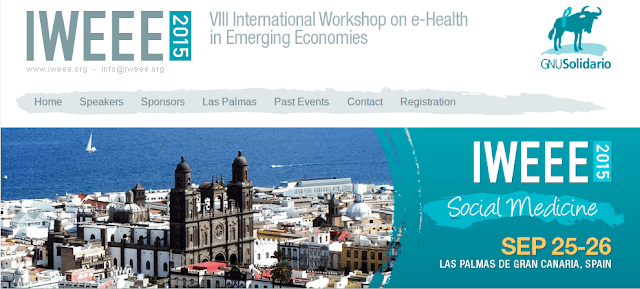
IWEEE 2015 Speakers

14 Friday Aug 2015

Tags

free software, fsf, gnu, GNU Health, GNU solidario, Hospital Information System, interoperability, IWEEE, Las Palmas, medical informatics, Public Health, richard stallman, Social Medicine, tryton

http://www.iweee.org/2015-las_palmas/speakers.html

Posted by Luis Falcon | Filed under events, GNU Health, GNU solidario

≈ Leave a comment

Call for Papers IWEEE 2015 : Social Medicine – People before Patients –

06 Monday Jul 2015

Posted by Luis Falcon in events, GNU Health, GNU solidario

≈ Leave a comment

Tags

#socialmedicine, free software, GNU Health, GNU Health, GNU solidario, healthcare, IWEEE, iweee2015, patients, Public Health, Salud Pública

The International Workshop on e-Health in Emerging Economies (IWEEE) is an annual conference for Free (Freedom) Software in Healthcare and Social Medicine advocates.

The workshop promotes Free Software as an effective and ethical solution to provide universality and equity in health care.

This year the theme of IWEEE is “People before Patients”. We will put the attention on health promotion and disease prevention. 

Share your government experiences and ideas, such as how your government is improving Public Health with Free Software, or personal health devices using open hardware.
IWEEE is a non-profit event organized by GNU SOLIDARIO.
If you are interested to participate, please submit your presentation at: papers@iweee.org

If you want to sponsor the event, please contact us via: sponsors@iweee.org

Please feel free to share this information with others people who may be interested.

*Deadline*

 If you wish to participate to the call for papers/posters :

*Abstract* *submission*: no later than 1st of August 2015

Paper and posters submission guidelines
We hope to see you in Las Palmas !

GNU Health at LIBREPLANET 2015

18 Wednesday Mar 2015

Posted by Luis Falcon in events, GNU Health, GNU solidario

≈ Leave a comment

Tags

ehealth, free software, gnu, GNU Health, GNU Health, GNU solidario, libreplanet2015, Public Health, software libre

Dr. Luis Falcón at LIBREPLANET 2015 will be presenting on March 22nd. 15:25 – 16:10 Session Block 5B:

“GNU Health: improving public health care with free software”

… LibrePlanet is an annual conference for free software enthusiasts. LibrePlanet brings together software developers, policy experts, activists and computer users to learn skills, share accomplishments and face challenges to software freedom … This year, the theme of LibrePlanet is “Free Software Everywhere.” 
[ LibrePlanet 2015 — Free Software Everywhere]                                            

GNU Solidario new partner

17 Friday Oct 2014

Posted by Luis Falcon in events, GNU Health

≈ Leave a comment

Tags

ehealth, free software, gnu, GNU Health, GNU solidario, HMIS, Public Health, Salud Pública, silex sistemas, Social Justice, Social Medicine

From GNU Solidario we would like to thank Sílex Sistemas for joining us in our GNU Health project !

“…Our commitment with the social contract of GNU Solidario also represents to us a recognition that software is much more than a business, but it is also a tool to guarantee the basic rights and the access to development and well being to mankind. Finally, it is a proof that it is possible to be ethical and to do good business.” Roberto Vasconcelos Novaes – Sílex Sistemas –

GNU Health version 2.6 released

07 Monday Jul 2014

Posted by Luis Falcon in GNU Health, HMIS

≈ Leave a comment

Tags

crypto module, digital signing, ehealth, EMR, free software, FreeBSD, genetics, GNU Health, GNU solidario, GNU/Linux, HMIS, Hospital Information System, obstetrics, Public Health, PUID, thymbra, tryton

Dear GNU Health community

After 6 months of work, we are very happy to announce GNU Health 2.6 series. This version improves the navigation, security and data integrity (health_crypto) and audit. It has also been designed to be used in distributed environments, such a network of public hospitals in a province or country.

Here is a partial list of the new features :

* Tryton 3.2 compatibility
* Universal Person Unique Identifier (PUID)
* Additional / alternative identification codes are now stored in
  the person (party) model.
* Crypto module (Document Digest, validation, digital
  signing/verification )
* Crypto tryton plugin (included in the backend directory of the
  tarball)
* Revision of models for Distributed deployments
* Health Archives module
* New Institution model
* Revised health specialties and disease groups
* Remove extra submenus, for usability.
* Revised medication model
* Improved Obstetrics module (eg, automatic obstetric GPA calculation)
* New shortcuts from the Patient and Institution Model.
* Improved Genetics module
* Revised Neonatolgy functionality. Newborn is assigned a PUID at birth
* New directory for custom modules
* Centralized Authentication / LDAP integration
* Audit trails from the client (thanks Tryton 3.2)
* Improved installation script (covers GNU/Linux distros and FreeBSD)
* Of course, upgrade path is included.

There are many other improvements and bug fixes that have not been included in this summary document. You can read the Changelog for a detailed description of all the activity.

** Installation :
—————-
If you are installing GNU Health as the first time, follow the instructions in https://en.wikibooks.org/wiki/GNU_Health/Installation

Note : The gnuhealth_install script tries to do a local installation, including the required Python packages. This version updates the python packages to one of the latest stable releases. If you are coming from a dedicated server for GNU Health, and used the official installation script, you should be OK. If you installed packages in a system-wide manner, then you would need to uninstall them before the update, otherwise the installation script won’t be able to upgrade them.

** Existing Installations : Upgrade procedure :
——————————

If you already have a GNU Health system in your health center, you should upgrade it to 2.6.0 . As always, the upgrade path is included in GNU Health.  The upgrade for version 2.6.0 is straight forward :

Follow the Upgrade Instructions in the Wikibook
https://en.wikibooks.org/wiki/GNU_Health/Upgrade

** Official Languages.
———————–
GNU Health now includes English, Chinese, French, Greek, Italian, Portuguese and  Spanish, as the official languages. The language packs of the official languages are included in the GNU Health package, with all the modules, so there is no need to download.

There are over 85 GNU Health language teams in Transifex. If you are a language maintainer and want to include your language for the next stable release, please send us a mail to health@gnusolidario.org .

Thanks !
——–

 A big thank you to my colleagues from GNU Health community; GNU Solidario; Thymbra and Tryton, and to the Free Software movement.

Enjoy the new version and report any bug / issues / improvements to
health@gnu.org !

PS: In the coming days we’ll be updating the Wikibook, so it reflects the new features of this version

Best,

—
Luis Falcon
GNU Health : Freedom and Equity in Healthcare
http://health.gnu.org
@gnuhealth

GNU Health: Freedom and Equity in Healthcare

12 Thursday Jun 2014

Posted by Luis Falcon in GNU Health, GNU solidario

≈ Leave a comment

Tags

clinical records, ehealth, equity, free software, gnu, GNU Health, GNU solidario, health system, healthcare, interoperability, Jamaica, medical history, primary care, Social Justice, Social Medicine

https://www.youtube.com/watch?v=ur8c8hW5Otg&feature=youtu.be&a

By Gabriela Brenes

PROGRAM IWEEE 2014

16 Friday May 2014

Posted by Luis Falcon in events, GNU Health, GNU solidario

≈ Leave a comment

Tags

Butterly Effect, ehealth, esalud, ethics, free software, gnu, GNU Health, GNU Health, GNU solidario, goverments, HMIS, IWEEE2014, Medical Devices, medical informatics, Social Medicine, software libre

The program may be subject to small changes due to circumstances beyond our control.

GNU Health Webinar

02 Friday May 2014

Posted by Luis Falcon in events, GNU Health

≈ Leave a comment

Tags

expediente clínico electrónico, free software, gnu, GNU Health, GNU solidario, historia clinica electronica, HMIS, paciente, software libre

Continuamos con la serie de Webinars en el grupo de la Red Centroamericana de Informática en Salud, invitándoles a participar en este Webinar sobre el uso práctico del software de expediente clínico electrónico GNU Health a ser impartido por los colegas de GNU Solidario. 
Ya está abierta la inscripción gratuita llenando el formulario: https://docs.google.com/forms/d/19D4VRSINhxvofmoVybGs8RqN7sAU3zoq_-JnqUGebQM/viewform. 
Los esperamos!!

Speakers’ Program IWEEE 2014

30 Wednesday Apr 2014

Posted by Luis Falcon in events, GNU Health, GNU solidario

≈ Leave a comment

Tags

CATAI, Cruz Roja, ehealth. esalud. education, floss, GNU Health, GNU solidario, goverments, IMIA, IWEEE2014, MDG6, Medical Devices, Public Health, Salud Pública, social determinants, Social Medicine, UNESCO

Dr. José A. Caminero

Dr. Caminero is a pulmonologist with 25 years of experience working in the area of tuberculosis. In the past 23 years he has worked in the Department of Pulmonology, General Hospital of Gran Canaria ” Dr. Negrin ” (Las Palmas, Canary Islands, Spain ). Since 1995 he has worked at the International Union Against Tuberculosis and Lung Disease (The Union, Paris, France) and since 2003 he is the unit coordinator of multi-drug resistant TB (MDR -TB) for this organization. Dr. Caminero is a member of the Green Light Committee (World Health Organization ) since 2002. Between 1994 and 1998 he was the chairman of the Scientific Committee of the Spanish Society of Pneumology and Thoracic Surgery (SEPAR ).Dr. Caminero has worked in various areas of TB (including HIV) in more than 50 developing countries, including Latin America and others like China, India, Philippines, Pakistan, Egypt, Syria, Namibia and South Africa, among others. Since 1996 he has taught many courses on TB worldwide (in English and Spanish), with emphasis on clinical management. He has published over 150 articles, and more than 50 publications in English. He has edited the guide to tuberculosis specialists (La Union, 2004) and four other books associated with tuberculosis. Dr. José A. Caminero has given more than 300 lectures at international conferences, and has received numerous awards in various scientific societies.


Dr. Olga Ferrer-Roca

MD. PhD. Born in Barcelona, studied Medicine in the Central University of Barcelona from 1966-1972 with Honors. Got the PhD with “Cariotyping and tissue culture of tumors” in 1974 with Honors. Specialized in Pathology in 1974 being trained in Paris, Milwakee-USA and London. Working as pathologist in the Clinic Hospital of Barcelona since 1972 got the Assistance Professorship in Pathology in 1974 and the Chair of Pathology of the University of La Laguna in 1982 […]Founded the CATAI association in 1993, being the president since then. Got the UNESCO Chair of Telemedicine in 1999 for the University of La Laguna. Since 1996 train on Telemedicine the students of medicine and Computer Science, creating the European Master of Telemedicine and Bioengineering applied to Telemedicine in 2004, at distance […]


Mr. Sebastián Lucas Marró

Mr. Marró is an IT Specialist and ERPs consultant. Member of GNU Solidario and Board member of the Tryton Foundation. He is an active member of the Argentinian Tryton Group. He actively contributes to the development of the Tryton Localization in Argentina. He currently holds the position of Director of Technology at Thymbra, where he cooperates with the GNU Health Project. He has been working and promoting the development of Free Software. He has given lectures and training about Tryton, GNU Health and Free Software in Latin America and Europe.


Dr. Luis Falcón

Dr. Falcón (Las Palmas, Spain) holds a degree in Computer Science and Mathematics from the California State University (USA) and in Medicine from IUCS, Buenos Aires (Argentina). Luis is a social, animal rights and Free/Libre Software activist. In 2006 he founded GNU Solidario, a nonprofit organization that delivers Education and Health to developing countries with Free Software. He is the author of GNU Health (http://health.gnu.org), the award-winning Free/Libre Health and Hospital Information System. He is the founder and CEO of Thymbra, a company with focus on ERP and Health Informatics.


Mr. Thomas Karopka 

Mr. Karopka has over 20 years working experience in the area of information and communication technologies. After working for 10 years in industry, he moved to academi where he worked for 5 years in the area of bioinformatics. In 2007 he became head of the eHealth department of the IT Science Center Rügen gGmbH, an institute of applied research in Germany. Since August 2011 he works for BioCon Valley GmbH a cluster management organisation for healthcare and biotechnology in Germany. He is currently chair of the Libre/Free Open Source Software Working Group of the European Federation of Medical Informatics (EFMI LIFOSS WG) and chair of the International Medical Informatics Open Source Working Group (IMIA OS WG). He is a member of the German Association for Medical Informatics, Biometry and Epidemiologyand the International Society for Telemedicine and eHealth.


Dr. Richard Fitton

Dr. Fitton, qualified as a doctor at Guy’s Hospital, London SE1 1974 and at present is a locum General Practitioner at Tameside and Glossop CCG. He has done an Electronic Record Development and Implementation Pilot project 2001, was a member of the Department of Health “copying letters to patients” working group 2004 and of the Member National Care record Development Board 2004 to 2005. He was a member of the Wellcome Trust working group on the secondary use of GP data for research 2006, a member of the GMC production team of the first guidance on sharing records with patients and a member of the Royal College of General Practitioners and Department of Health Working group on patients accessing their records – in 2012. Engagement with Wellmed record USA in 1999 to 2001, the International Council of Medical compunetics conferences in 2006, 2007, 2008 and had consultations with the UNESCO moderator and ex secretary of the UNESCO working group on the use of human genetic data in 2008. He has presented at the WHO FIC Trieste 2007 and at the International Conferences on Urban Health Nairobi, New York and Manchester. He conducted the Joy Project 2003: 50 patients correcting their own record. Patients correcting records after the Shipman murders 2005 Tameside and Glossop PCT.


Dr. Alejandro José Sánchez Camejo

Dr. Sánchez Camejo is a surgeon from the University of Zulia (L.U.Z.). Faculty of Medicine. He has a Training residency in health care at University Hospital “Dr. Adolfo D´Empaire” surgical Department (2002-2005). Informédica Group. Applied Telemedicine course. February 2004. Miami – FL. USA. Final project: Teledismorphology. Applied to Telemedicine in diagnosing congenital malformations. he has a Master in Esthetic Medicine. Medical Aspects and Interventionists form the Balearics University. Palma de Mallorca, February 2007-2008. He has been giving multiple courses and workshops at national and international level, not only in the health care residence but also in the esthetic medicine specialization. He has published multiple publications on international magazines, as well as, participation at congresses as speaker at national and international level. He has excellent computer science skills on medical area. Venezuela Telemedicine group Founder (2005) at University Hospital Dr. Adolfo D’Empaire. University of Zulia. Cabimas (Venezuela). Member of the Spanish Esthetics Society (SEME). Member of the Official College of Doctors’ from Las Palmas de Gran Canaria.


Dr. Alberto Lazzero

Dr. Lazzero is an Emergency Physician at West Turin Hospital Federation – Local Health Unit TO 3, United Hospitals of Pinerolo (Turin Area). He is Professor of Emergency Medicine at the University of Turin, Faculty of Medicine “San Luigi”, School of Nursing. He is also Professor of Emergency Care in Telemedicine and Telepharmacy in an International Master on eHealth at University of Camerino, Faculty of Pharmacy. University education: Degree in Medicine and Surgery, magna cum laude (Turin, Italy). Specialization in Endocrinology, with special interest for critical patients, magna cum laude (Turin, Italy). University Diploma in Chronobiology (Paris, France). University Diploma in Emergency Medicine (Nice, France). Master of Science in eHealth, magna cum laude (Camerino, Italy). He is member of several scientific societies including the Federazione delle Associazioni dei Dirigenti Medici Internisti (FADOI), the Società Italiana di Medicina d’Emergenza e Urgenza (SIMEU) and the International Society for Telemedicine and eHealth (ISfTeH). In 2010 founded ZOHE – E-Health Open Zone, a no-profit association that aims to promote health care through knowledge, research and innovation, trying to combine sustainability, health and people with a special interest for emerging economies.

Mr. Musa Suso

Mr. Suso is from Gambia and started working for Ministry of Health & Social Welfare in Gambia in 2004 . After the Health record Management training at Royal Vitoria Teaching Hospital he was posted to Farafenni Regional Health Team in the rural Gambia and also oversea the Farafenni Hospital as Regional Dater Entry Clerk. In 2005 after the Data Management training course with ICM London, he was promoted as a Senior Data Entry and again posted to Bansang Hopital in rural Gambia. After his BSc in Computer Science at the University Of The Gambia full sponsored by Ministry of Health and he was promoted as a Data Manager in the central Health Information System office and in June 2013  he was promoted again as an ICT office for the Ministry of Health.


Dr. Shinji Kobayashi

Dr. Kobayashi was born in 1970 Saga. He graduated from the graduate school of Kyushu university with MD, PhD. His research area is Open Source Software in medicine and Ruby implementation of the openEHR standards. He has been a lead of Medical Open Source Software Council in Japan from 2003.


Mr. Jorge Raul Valera de Fez

Mr. Valera de Fez Has a degree in Sociology and Social Sciences (Spain, 2002). AMaster inScience of Labour and Education (France, 2005)and he has a Training as a Specialist inInternational Marketing (Spain, 2008). Jorge has been working and applying his knowledge in various companies, until hebegan his work with the Red Cross. He currently holds the position of Referrer Regional Volunteer, in charge of coordination and management of volunteers in the four counties of the island of Gran Canaria (Spain).


Dr. Claudia Pagliari

P { margin-bottom: 0.21cm; }A:link { }

Convenor, eHealth Interdisciplinary Research Group; Programme Director MSc in Global eHealth, The University of Edinburgh. Dr Pagliari is an interdisciplinary researcher specialising in the study, design and evaluation of eHealth. This includes studies of remote patient monitoring, mHealth, online interventions, virtual robots, personal health records, social media, and digital health in low income countries, as well as research on the ethics and public acceptability of (big) data mining and linkage. She also leads masters programmes in Health Informatics, Health Information Governance and Global eHealth, supervises PhD students and sits on several UK and international advisory boards in the area.

Psic. Tais Pérez

Health psychologist specialized in nephrology (psychonephrology). MA in Clinical Practice in Mental Health, MA in Behavioral and Health Science Methodology and MA in Systemic Family Therapy. Currently developing her career in the field of chronic kidney disease, working with patients with kidney disease at the General Hospital of Gran Canaria “Dr. Negrín”. Founder of RenalHelp, the first complete web platform and mobile application to support patients with chronic kidney disease (www.myrenalhelp.com).

← Older posts
Newer posts →

Recent Posts

  • Gracias, India
  • Parallel and distributed computing in GNU Health
  • El cambio de horario es un atentado contra la salud. Rechazarlo es la mejor medicina
  • Tu finca, su infierno
  • La Cátedra de Animales y Sociedad de la URJC: Un referente de empatía y respeto hacia los animales.

Archives

  • September 2025
  • May 2025
  • March 2025
  • February 2025
  • May 2024
  • July 2023
  • March 2023
  • February 2023
  • January 2023
  • October 2022
  • August 2022
  • April 2022
  • February 2022
  • September 2021
  • August 2021
  • July 2021
  • June 2021
  • March 2021
  • December 2020
  • September 2020
  • July 2020
  • May 2020
  • March 2020
  • February 2020
  • November 2019
  • October 2019
  • June 2019
  • April 2019
  • May 2018
  • November 2017
  • October 2017
  • June 2017
  • May 2017
  • April 2017
  • March 2017
  • February 2017
  • January 2017
  • December 2016
  • November 2016
  • October 2016
  • September 2016
  • August 2016
  • July 2016
  • June 2016
  • May 2016
  • April 2016
  • March 2016
  • February 2016
  • January 2016
  • November 2015
  • October 2015
  • September 2015
  • August 2015
  • July 2015
  • May 2015
  • March 2015
  • February 2015
  • January 2015
  • December 2014
  • October 2014
  • September 2014
  • July 2014
  • June 2014
  • May 2014
  • April 2014
  • March 2014
  • December 2013
  • November 2013
  • October 2013
  • September 2013
  • August 2013
  • July 2013
  • June 2013
  • May 2013
  • April 2013
  • March 2013
  • February 2013
  • January 2013
  • December 2012
  • November 2012
  • October 2012
  • September 2012
  • August 2012
  • July 2012
  • June 2012
  • May 2012
  • April 2012
  • March 2012
  • February 2012
  • January 2012
  • December 2011
  • November 2011
  • October 2011
  • September 2011
  • August 2011
  • July 2011
  • June 2011
  • May 2011
  • April 2011
  • March 2011
  • February 2011
  • January 2011
  • December 2010
  • November 2010
  • October 2010
  • September 2010
  • August 2010
  • July 2010
  • June 2010
  • May 2010
  • April 2010
  • March 2010
  • February 2010
  • January 2010
  • December 2009
  • November 2009
  • October 2009
  • September 2009
  • August 2009
  • July 2009
  • June 2009
  • May 2009
  • February 2009
  • November 2008
  • October 2008
  • September 2008
  • December 2007
  • October 2006

Categories

  • #FHIR
  • animal liberation
  • animal rights
  • embedded
  • events
  • gnu
  • GNU Health
  • GNU solidario
  • HMIS
  • KDE
  • Libre Software
  • LIMS
  • medical
  • MyGNUHealth
  • Public Health
  • thalamus
  • tryton
  • Uncategorized

Meta

  • Create account
  • Log in
  • Entries feed
  • Comments feed
  • WordPress.com

Blog at WordPress.com.

  • Subscribe Subscribed
    • MeanMicio
    • Already have a WordPress.com account? Log in now.
    • MeanMicio
    • Subscribe Subscribed
    • Sign up
    • Log in
    • Report this content
    • View site in Reader
    • Manage subscriptions
    • Collapse this bar